Account-based marketing sounds straightforward in theory. Pick your best-fit accounts, create personalized campaigns, and watch the pipeline grow. In practice, most ABM programs stumble before they even launch because the data foundation is not there.
You cannot personalize outreach to an account when you do not know their tech stack. You cannot multi-thread into a buying committee when you only have one contact per account. You cannot time your campaigns to buying windows when you have no intent data.
This is the ABM pre-launch checklist that nobody gives you. The data thresholds you need to hit before spending a dollar on campaign creative.
The Minimum Viable Data for ABM
Think of ABM data requirements in three tiers: must-have (program does not work without it), should-have (significantly improves results), and nice-to-have (incremental improvement).
Must-Have Data
Verified email for 80%+ of contacts. If you cannot reach your contacts by email, your ABM campaigns cannot run. Email is still the primary outreach channel for ABM. Anything below 80% email coverage means significant gaps in your ability to engage buying committee members.
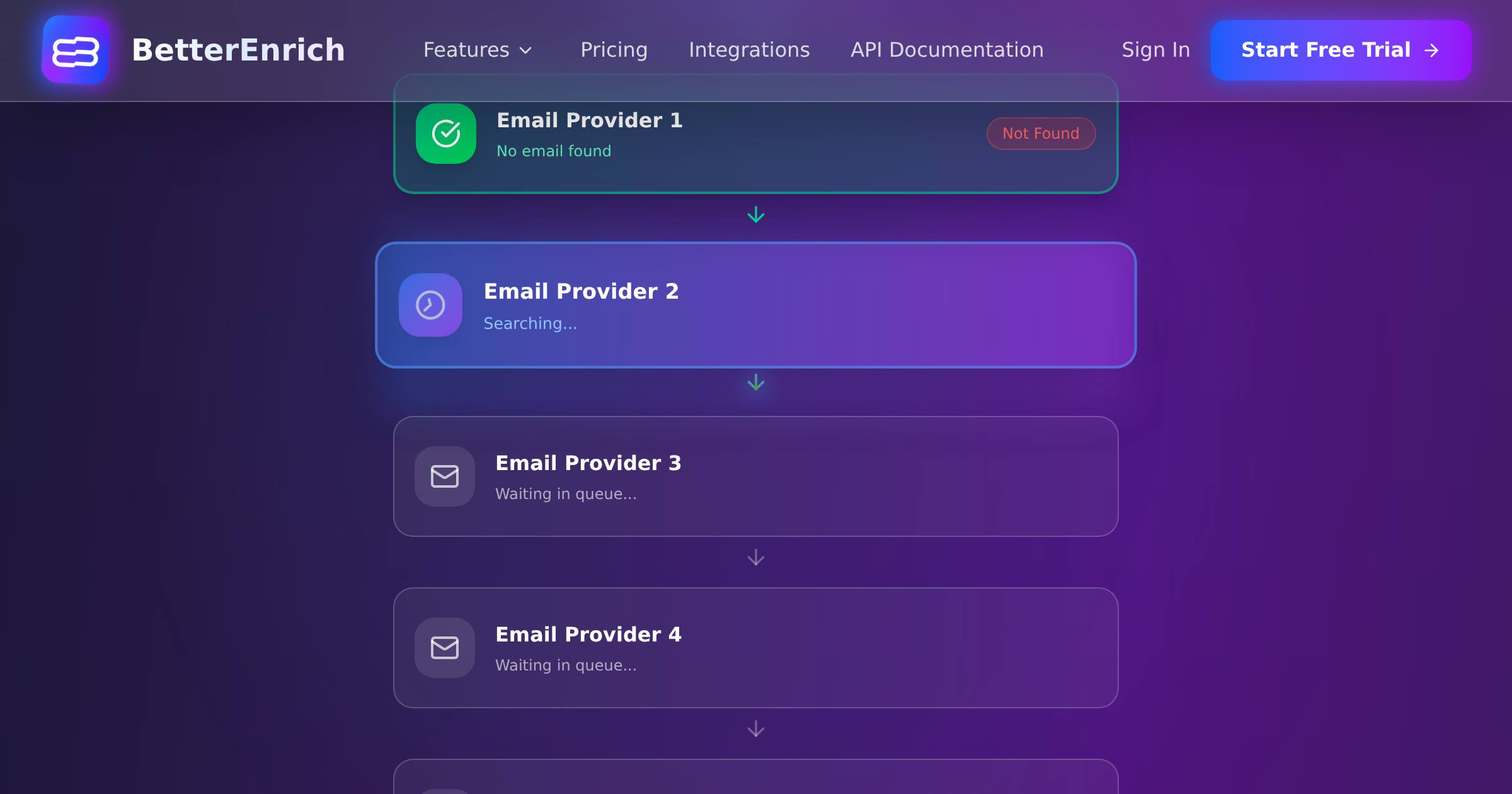
How to get there: run your contact list through a waterfall enrichment tool. Single-source tools typically deliver 50 to 70% email coverage. Waterfall enrichment like BetterEnrich pushes this to 85 to 95% by cascading across multiple data providers.
Direct dial for 40%+ of key contacts. Phone outreach is critical for ABM, especially for engaging economic buyers and champions who are harder to reach by email. A 40% direct dial rate on your key contacts (champion, economic buyer) is the minimum threshold for effective phone-based engagement.
Firmographic data on all accounts. At minimum: industry, employee count, revenue range, headquarters location. This is the baseline for account selection, scoring, and personalization. Without it, your targeting is guesswork.
At least one intent signal source. ABM without intent data is like fishing without a fish finder. You might catch something, but you are not optimizing your effort. Even one intent source (Bombora, G2, or your own website visitor identification) transforms account prioritization.
Data freshness within 90 days. B2B data decays at roughly 2% per month. Data older than 90 days has lost 6% or more of its accuracy. For ABM, where personalization and precision matter, stale data undermines your entire program.
Should-Have Data
Technographic data for target accounts. What technology stack does each account use? This enables competitive displacement campaigns, integration-based messaging, and technical fit assessment. Technographic data is particularly powerful for ABM because it creates natural conversation starters.
3 to 5 contacts per Tier 1 account. ABM is about engaging accounts, not individuals. Having multiple contacts across the buying committee lets you multi-thread your outreach and increases deal velocity by 2 to 3 times.
Company growth signals. Recent funding, hiring trends, office expansions, and revenue growth indicate budget availability and strategic priorities. These signals help you time your outreach and tailor your messaging.
LinkedIn profile URLs. Social selling is a core ABM channel. Having LinkedIn URLs for your contacts enables coordinated outreach across email, phone, and social.
Nice-to-Have Data
Engagement history. Prior interactions with your website, content, or events. This helps warm up conversations and demonstrates that the account has existing awareness of your brand.
Organizational hierarchy data. Reporting relationships within the account help you navigate the buying committee and identify who influences whom.
Competitive intelligence. Which competitors does the account currently use? When do contracts expire? This information is powerful but harder to obtain systematically.
Assessing Your Current Data Readiness
Before launching ABM, run this diagnostic on your existing data:
Account-Level Assessment
For your proposed target account list, answer these questions:
- What percentage of accounts have complete firmographic data (industry, size, revenue, location)?
- What percentage have at least one intent signal in the past 90 days?
- What percentage have technographic data?
- How old is the most recent firmographic data update?
Benchmark: you want 90%+ firmographic completeness, 50%+ intent coverage, and data updated within the last quarter.
Contact-Level Assessment
For the contacts you have at your target accounts:
- Average number of contacts per account?
- Percentage with verified email?
- Percentage with direct dial phone?
- Percentage with current job title confirmed in the last 90 days?
- What roles are represented (economic buyer, champion, technical evaluator)?
Benchmark: you want 3+ contacts per account, 80%+ verified email, 40%+ direct dial, and representation across at least 2 buying committee roles per account.
The Data Gap Analysis
Compare your current state against the benchmarks above. The gaps tell you exactly what enrichment work needs to happen before launch.
Common gaps:
- Too few contacts per account (most common). Solution: bulk contact enrichment by account, department, and seniority.
- Low email verification rate. Solution: run existing emails through verification, re-enrich with waterfall tool for missing emails.
- No phone numbers. Solution: phone-specific enrichment with mobile line-type verification.
- Stale data. Solution: re-enrichment of all contacts older than 90 days.
- No intent data. Solution: subscribe to at least one intent provider (Bombora, 6sense, or implement website visitor identification).
The Pre-Launch Enrichment Sprint
Once you know your gaps, run a focused enrichment sprint to close them. Here is a typical timeline:
Week 1: Account Data Enrichment
- Enrich all target accounts with firmographic and technographic data
- Score and re-rank accounts based on enriched data
- Finalize account list and tier assignments
Week 2: Contact Discovery and Enrichment
- Identify buying committee roles for each account
- Run contact enrichment for all target roles at all accounts
- Verify all emails and phone numbers
- Import enriched contacts into CRM with account associations
Week 3: Intent Data Integration
- Connect intent data source(s) to your workflow
- Map intent topics to your product and buying process
- Identify currently in-market accounts for priority outreach
- Set up ongoing intent signal monitoring
Week 4: Data Quality Validation
- Run quality checks against all benchmarks
- Fill remaining gaps through targeted enrichment
- Set up data refresh schedules (quarterly re-enrichment at minimum)
- Configure suppression lists and compliance documentation
Ongoing Data Maintenance for ABM
Launching with great data and then letting it decay defeats the purpose. ABM data maintenance should be continuous:
Monthly: Re-verify email deliverability for contacts in active campaigns. Update engagement status for all contacts. Add new contacts discovered through outreach interactions.
Quarterly: Full re-enrichment of all contacts at target accounts. Re-run ICP scoring with updated firmographic data. Review and update buying committee maps. Evaluate intent data signals for account re-prioritization.
Semi-annually: Comprehensive target account list review. Add new accounts, remove accounts that no longer fit. Full data quality audit against benchmarks.
Budgeting for ABM Data
ABM data is not free, but it is far cheaper than the campaigns it supports. Here is a rough budget framework:
Contact enrichment: $0.02 to $0.15 per contact. For 500 contacts across 100 accounts: $10 to $75 per enrichment cycle.
Intent data: $500 to $5,000 per month depending on the provider and coverage.
Technographic data: Often included in enrichment tools or available for $100 to $500 per month.
Email verification: $0.003 to $0.01 per verification. Negligible cost.
Total data budget for a mid-size ABM program: $500 to $5,000 per month. Compare that to the cost of ABM campaigns (content creation, advertising, events) which typically run $10,000 to $50,000+ per month. Data is 5 to 10% of your ABM budget but determines whether the other 90 to 95% produces results.
Do not launch ABM without the data foundation. The four-week enrichment sprint described above is a small investment that determines whether your program generates pipeline or just burns budget.