Why Your Enriched Email List Still Has Bounces (And How to Fix It)
You did everything right. You used a reputable enrichment tool to find email addresses. The emails came back as verified. And yet when you sent your campaign, 3 to 4 percent of them bounced. What happened?
This is one of the most frustrating experiences in outbound sales, and it is more common than most enrichment vendors want to admit. The gap between enrichment verification and actual deliverability has several causes, all of them fixable once you understand what is going on.
Cause 1: The Time Gap Between Enrichment and Send
This is the single biggest reason enriched lists still have bounces. B2B contact data decays at 2.1 percent per month. If you enriched and verified a list two months ago, roughly 4 percent of those addresses have likely gone stale. The person changed jobs, the company restructured, or the email account was deactivated.
The fix is simple but often overlooked: re-verify immediately before sending. Not at enrichment time. Not a week before the campaign. The day of the send, or at most the day before. Verification costs fractions of a cent per email, so there is no good reason to skip this step.
Cause 2: Catch-All Domains
Catch-all domains are configured to accept email for any address at their domain, whether the specific mailbox actually exists or not. When you verify an email at a catch-all domain, the verification tool gets an acceptance response from the mail server regardless of whether john.smith@company.com is a real mailbox.
This means verification cannot tell you whether a specific address at a catch-all domain is valid. It can only tell you that the domain accepts everything. The email might go to a real person, or it might get accepted, find no matching mailbox, and bounce after the fact.
The fix is to treat catch-all addresses differently in your sending strategy. Send to them in smaller batches, monitor bounce rates closely, and use pattern confidence scoring. If the email was sourced from a reliable enrichment provider and matches common patterns (first.last@), it is more likely to be valid than a random guess.
Cause 3: Temporary Server Issues
Sometimes emails bounce not because the address is invalid but because the receiving server is temporarily unavailable. These are soft bounces and they resolve on their own when the server comes back online. Most sending platforms automatically retry soft bounces, but some report them in aggregate bounce metrics, which makes your bounce rate look worse than it actually is.
The fix: differentiate between hard and soft bounces in your reporting. Only hard bounces indicate data quality problems. Soft bounces are infrastructure noise that usually resolves within hours.
Cause 4: Aggressive Spam Filters
Some corporate email systems are configured so aggressively that they reject emails from unknown senders at the server level before the message even reaches the inbox. This looks like a bounce in your sending reports, but the email address itself is perfectly valid. The server just refused the delivery based on sender reputation or content analysis.
The fix is a combination of better domain warming (see our guide on warming up new domains), improved email content (avoid spam trigger words), and gradual volume increases. These are not data quality problems. They are deliverability problems.
Cause 5: Enrichment Quality Varies by Provider
Not all enrichment tools produce the same quality results. Industry benchmarks show hard bounce rates ranging from 0.9 percent (best in class) to 11.2 percent across different enrichment providers. A 14.7 percent mismatch rate between company names and email domains has been documented in some tools, meaning the email belongs to a different company than the one you think you are targeting.
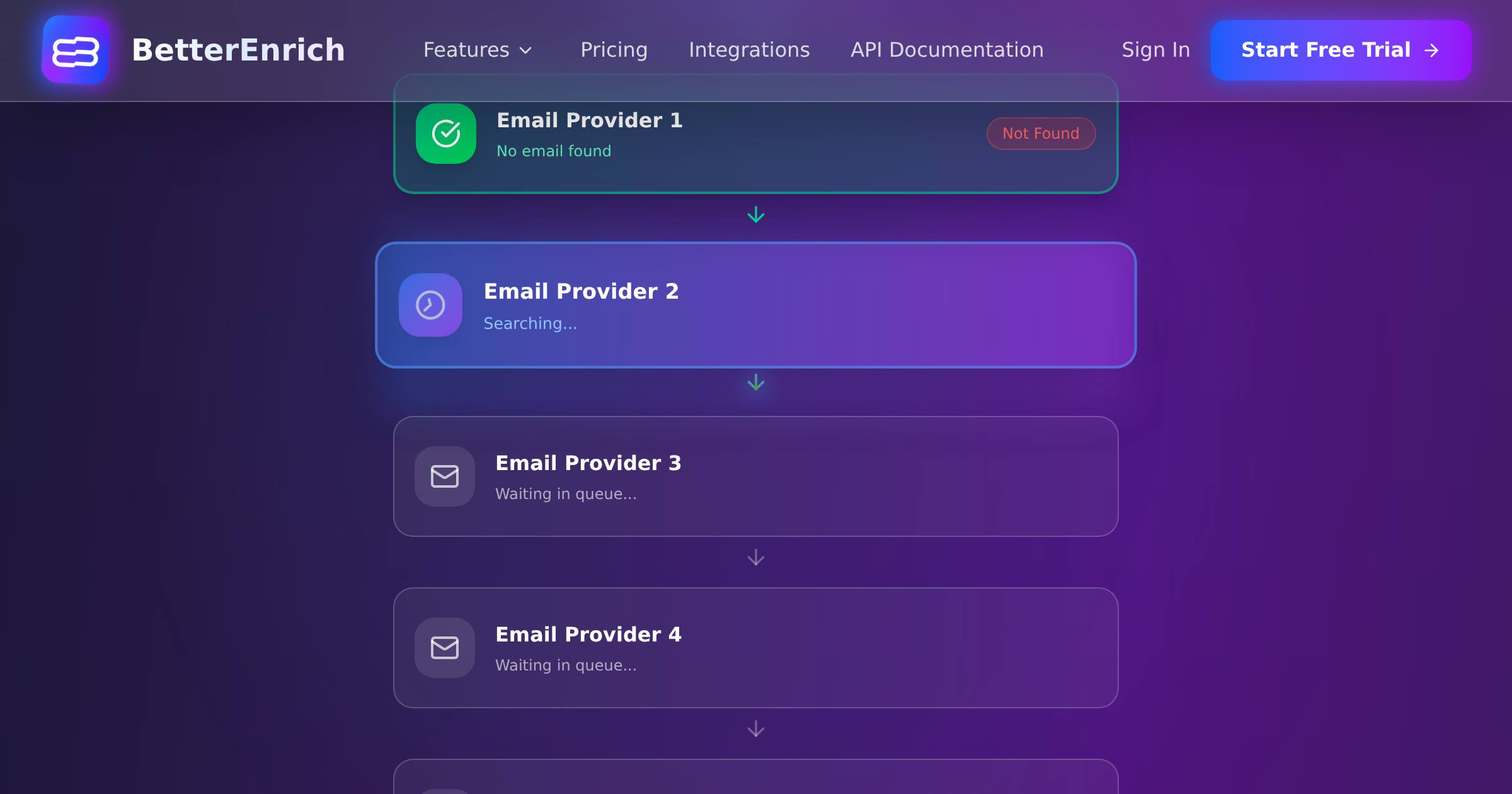
The fix: choose enrichment providers with proven accuracy track records. Waterfall enrichment tools like BetterEnrich cascade through 17 or more data sources and include verification in the enrichment process, which eliminates most quality issues before the data reaches your CRM.
Cause 6: Role-Based and Group Addresses
Addresses like info@company.com, sales@company.com, and support@company.com are technically valid and will pass verification. But they are shared inboxes, not personal addresses. They often have stricter spam filtering, higher bounce rates on cold outreach, and they generate more spam complaints because multiple people monitor them.
The fix: flag role-based addresses during verification and exclude them from cold outreach sequences. If the only email you have for a company is a role-based address, go back to enrichment and specifically request a personal work email.
Cause 7: Email Forwarding and Aliases
Some companies use email forwarding or aliasing systems where the address you see is not the actual mailbox. The email gets accepted at the alias domain, forwarded to the real mailbox, and if the real mailbox is full or the forwarding breaks, the bounce happens after the initial acceptance. Your verification tool saw an acceptance, but the email ultimately did not deliver.
The fix: there is no clean solution for this one. Forwarding failures are unpredictable and undetectable during verification. The best mitigation is to monitor delivery receipts and engagement signals. If an email is consistently undelivered despite passing verification, remove it and try to find an alternative address through re-enrichment.
Building a Bounce-Resilient Workflow
Here is the complete workflow for minimizing bounces from enriched lists:
- Enrich with a waterfall provider that sources from multiple databases (higher initial accuracy)
- Verify at enrichment time (catch obvious invalids immediately)
- Re-verify before sending (catch addresses that decayed between enrichment and send)
- Segment catch-all addresses into a separate sending batch with lower daily limits
- Exclude role-based addresses from cold outreach sequences
- Monitor bounces in real-time during campaign execution
- Auto-pause if bounce rate exceeds 2 percent mid-campaign
- Post-campaign cleanup: remove all hard bounces permanently, investigate soft bounces
What a Realistic Bounce Rate Looks Like
If you follow this workflow with a quality enrichment provider, here is what to expect:
- Hard bounce rate: 0.5 to 1.5 percent (some decay and catch-all failures are inevitable)
- Soft bounce rate: 0.5 to 1.0 percent (temporary server issues)
- Total bounce rate: 1.0 to 2.5 percent
Getting below 1 percent total bounces consistently is possible but requires very fresh data (enriched and verified within 48 hours of sending) and careful catch-all management.
The Bottom Line
Zero bounces from an enriched list is not a realistic goal. But keeping bounces below 2 percent absolutely is. The keys are re-verifying close to send time, handling catch-all domains carefully, choosing enrichment providers with strong accuracy, and monitoring in real-time so you can pause before damage compounds. Every percentage point you shave off your bounce rate protects your domain reputation and improves the deliverability of every future email you send.