Clay and BetterEnrich both believe in waterfall enrichment. They both acknowledge that querying multiple data sources produces better coverage than relying on a single database. But they take dramatically different approaches to implementation. Clay gives you the building blocks to construct your own waterfall. BetterEnrich gives you a finished product. The choice comes down to how much control you want versus how much setup time you are willing to invest.
The Clay Approach: Build Your Own Waterfall
Clay is fundamentally a data orchestration platform. It connects to over 100 data sources and provides a spreadsheet-like interface where you build custom enrichment workflows. You decide which data providers to query, in what order, with what logic, and how to handle the results.
The power of Clay is flexibility. You can build enrichment sequences that are precisely tailored to your ICP. If you know that Provider A is strongest for tech companies, Provider B is strongest for healthcare, and Provider C has the best European data, you can build conditional logic that routes lookups to the right provider based on the prospect's characteristics.
Clay charges based on workspace-level credits with no per-seat pricing. This means you can give your entire team access without cost scaling linearly with headcount. The credit system lets you tune spending at a granular level, allocating more credits to high-priority enrichment tasks and fewer to exploratory lookups.
The trade-off is setup and maintenance. Building a custom waterfall in Clay requires understanding the strengths and weaknesses of each data provider, configuring the cascade logic, handling error cases, and maintaining the workflow as provider APIs change. This is genuine engineering work, not a five-minute configuration.
The BetterEnrich Approach: Turnkey Waterfall
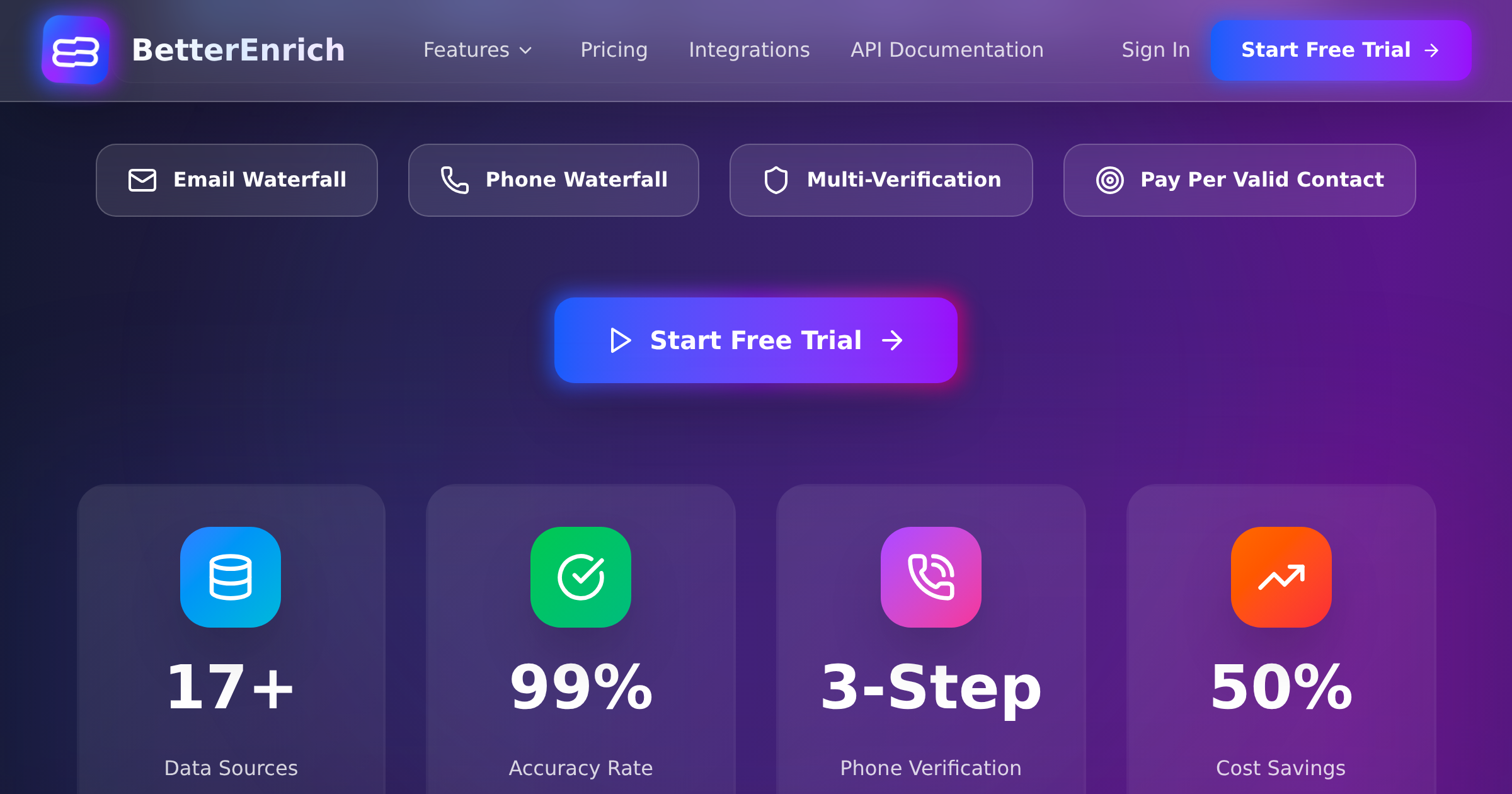
BetterEnrich abstracts the complexity of waterfall enrichment into a single API call. You send an email address or name plus company domain, and the platform handles everything else: provider selection, cascade ordering, result ranking, verification, and response. You get back the best available data from 17 or more sources without needing to know which source provided it.
The advantage is time to value. You can go from signup to enriching contacts in minutes rather than days. The 100 free credits with no credit card required let you test the platform against your actual data before committing. There is no workflow to build, no provider APIs to configure, and no cascade logic to maintain.
BetterEnrich's pay-per-valid pricing means you only pay for contacts that return verified data. The platform handles provider cost optimization internally, routing lookups to minimize cost while maximizing coverage. You do not need to think about per-provider pricing because BetterEnrich manages that layer for you.
Coverage Comparison
Both tools deliver waterfall-level coverage, which typically ranges from 85 to 95 percent. The coverage difference between them is less about the waterfall concept and more about which specific data sources are included in each tool's cascade.
Clay accesses over 100 data sources, but you typically use 5 to 10 in a given workflow because each additional source adds complexity and credit cost. BetterEnrich cascades through 17 or more premium sources automatically, with the platform selecting the optimal query path for each lookup.
In practice, coverage rates are similar when Clay workflows are well-configured. The difference is that Clay's coverage depends on your workflow design skills, while BetterEnrich's coverage is consistent regardless of how technically sophisticated the user is.
Cost Analysis
Clay's credit model means your enrichment cost depends on how many data sources you query per lookup and which providers you use. A simple waterfall checking 3 sources costs less per lookup than a comprehensive waterfall checking 10 sources. This granularity is both a feature and a challenge. You have more control but also more decisions to make.
BetterEnrich's pay-per-valid pricing simplifies the cost calculation: you pay X per verified email, Y per verified phone number. No math required to figure out per-lookup costs because the pricing is outcome-based rather than input-based.
For teams enriching fewer than 1,000 contacts per month, the cost difference is small enough that the decision should be based on workflow fit rather than pricing. For teams enriching 5,000 or more contacts per month, the total cost of each approach should be modeled based on your specific lookup patterns.
Technical Requirements
Clay requires more technical sophistication but less traditional engineering. The spreadsheet interface is accessible to operations professionals and business analysts. You do not need to write code, but you need to understand data structures, API logic, and conditional workflows. Expect 2 to 5 days of setup for a production-quality waterfall workflow.
BetterEnrich requires basic API integration skills for anything beyond manual CSV uploads. The API documentation at betterenrich.readme.io provides clear examples, and the Zapier, Make, and n8n integrations offer no-code options. Expect 1 to 2 hours for basic setup and a few days for a fully automated enrichment pipeline.
If your team includes someone who enjoys building data workflows and has time to maintain them, Clay is rewarding. If your team needs enrichment working as quickly as possible with minimal ongoing maintenance, BetterEnrich is the faster path.
Maintenance and Ongoing Management
Clay workflows require ongoing maintenance. Data providers change their APIs, adjust pricing, modify response formats, or alter their coverage. When a provider in your Clay waterfall changes something, you need to update your workflow. Provider performance also shifts over time, meaning the optimal cascade order from three months ago may not be optimal today.
BetterEnrich handles provider management internally. When a data source in their waterfall changes, their engineering team updates the integration. When provider performance shifts, their routing algorithm adapts. You do not see any of this because it happens behind the platform layer.
This maintenance difference matters more than most teams anticipate. Building a Clay waterfall is a project. Maintaining a Clay waterfall is an ongoing responsibility. BetterEnrich turns that responsibility into a service you pay for.
Use Case Comparison
Clay shines when you need enrichment combined with complex data operations. If your workflow involves enriching a lead, then researching their company's tech stack, then finding related contacts at the same company, then scoring the account based on custom criteria, Clay's orchestration capabilities handle the entire sequence. It is a data workflow tool that includes enrichment, not just an enrichment tool.
BetterEnrich shines when enrichment is your primary need and you want it done well with minimal overhead. If your workflow is straightforward, find and verify contact data for these people, BetterEnrich delivers that with less setup, less maintenance, and outcome-based pricing.
When to Choose Clay
Choose Clay if you have a technical operations person who can build and maintain workflows, you need enrichment as part of a broader data orchestration process, you want maximum control over provider selection and cascade logic, you value flexibility over simplicity, and your use cases go beyond basic contact enrichment into complex data workflows.
When to Choose BetterEnrich
Choose BetterEnrich if you want enrichment working immediately with minimal setup, your team does not have bandwidth to build and maintain custom workflows, you prefer outcome-based pricing where you only pay for results, you need reliable enrichment without dependency on a workflow builder's expertise, and your primary need is finding and verifying contact data rather than building complex data pipelines.
Some teams use both. Clay for complex, custom workflows that require orchestration across many data sources, and BetterEnrich as a reliable enrichment provider within those Clay workflows or for simpler enrichment tasks that do not need Clay's orchestration layer.