How Data Enrichment Quality Affects Your Spam Score
When people think about spam filters, they think about email content. Avoid certain words, do not use too many links, skip the images. And those things matter. But there is an upstream factor that has an even bigger impact on whether your emails get filtered: the quality of the data you used to build your sending list.
The connection is not intuitive, so let us trace the chain from enrichment quality to spam score step by step.
How Spam Scoring Works
Modern spam filters do not just scan your email content. They evaluate a matrix of signals that collectively determine a spam score. The lower the score, the more likely your email reaches the inbox. The higher the score, the more likely it goes to spam or gets rejected.
The major signals include:
- Sender reputation: Your domain and IP reputation based on historical sending behavior. This is the single biggest factor and it is directly influenced by data quality.
- Authentication: Whether SPF, DKIM, and DMARC pass. A hygiene factor that should always be green.
- Content analysis: Spam trigger words, link density, image-to-text ratio, formatting patterns.
- Engagement history: How recipients have interacted with your previous emails. Opens, replies, and marking as important lower your spam score. Spam complaints and deletions-without-reading raise it.
- Bounce rate: High bounce rates signal poor list quality, which is associated with spam behavior.
- Complaint rate: The percentage of recipients who mark your email as spam.
The Data Quality Chain Reaction
Bad enrichment data creates a negative feedback loop that progressively increases your spam score:
Stage 1: Bad Data Enters Your CRM
You use an enrichment tool with mediocre accuracy. Some emails are wrong. Some belong to different people than you think. Some are at companies the contact no longer works at. Your CRM does not know this. The records look fine on the surface.
Stage 2: Bounces and Mismatches
You launch your campaign. Wrong emails bounce. Mismatched contacts receive irrelevant messages and either ignore them or mark them as spam. Both signals are negative.
Stage 3: Reputation Damage
Mailbox providers observe the bounces and complaints. Your sender reputation score drops. The threshold varies by provider, but a bounce rate above 5 percent or a complaint rate above 0.1 percent will start moving you toward spam classification.
Stage 4: Spam Filtering Kicks In
With a damaged reputation, even your emails to valid, interested prospects start getting filtered. They pass authentication, have clean content, and go to the right person, but the receiving server has learned that emails from your domain tend to generate negative signals. So it routes them to spam to be safe.
Stage 5: Engagement Collapse
With more emails going to spam, your open rates drop. Lower open rates further damage your reputation because providers see low engagement as a sign that recipients do not want your emails. The spiral continues.
This entire chain reaction starts with one thing: the quality of the data you enriched your list with.
Quantifying the Impact
Let us put numbers on this. Say you send 1,000 cold emails per week from two scenarios:
Scenario A: Low-quality enrichment (single-source, no additional verification)
- Bounce rate: 7 percent (70 bounces per week)
- Mismatch/wrong person rate: 10 percent (100 emails to wrong contacts)
- Spam complaint rate from mismatches: 5 percent of mismatches = 5 complaints per week
- Cumulative effect after 4 weeks: 280 bounces and 20 complaints
- Result: reputation significantly damaged, inbox placement drops to 60 to 70 percent
Scenario B: High-quality enrichment (waterfall, verified, pay-per-valid)
- Bounce rate: 1 percent (10 bounces per week)
- Mismatch/wrong person rate: 2 percent (20 emails to wrong contacts)
- Spam complaint rate: 1 complaint per week
- Cumulative effect after 4 weeks: 40 bounces and 4 complaints
- Result: reputation maintained, inbox placement stays above 85 percent
The difference in inbox placement between these two scenarios directly translates to the number of prospects who actually see your emails. At 1,000 sends per week, the gap is roughly 150 to 250 additional emails reaching inboxes in Scenario B. Over a quarter, that adds up to thousands of additional impressions and proportionally more replies and meetings.
Which Enrichment Quality Factors Matter Most for Spam Scores
Email Accuracy
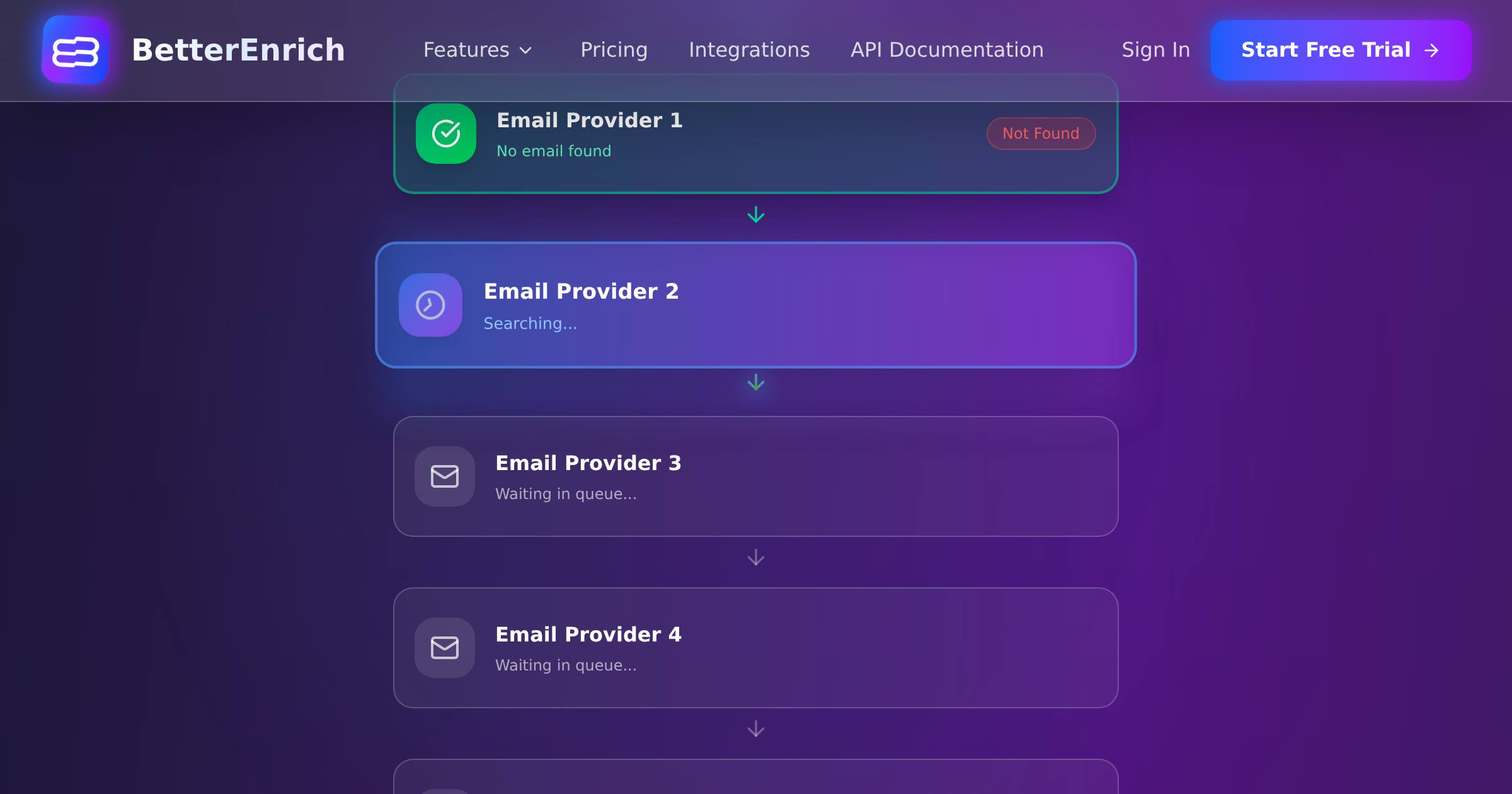
The most direct factor. Invalid emails cause hard bounces, and bounces are the primary driver of reputation damage. Waterfall enrichment tools like BetterEnrich that cascade through 17 or more sources and verify results produce significantly lower bounce rates than single-source tools.
Contact-Company Match Accuracy
When the email is technically valid but belongs to a different person or company than you expect, the personalization in your outreach will be wrong. The recipient either ignores the irrelevant email (killing engagement metrics) or reports it as spam (directly increasing complaint rate). A 14.7 percent mismatch rate, documented in some enrichment tools, means nearly 1 in 7 emails could generate these negative signals.
Data Freshness
Enrichment data that is months old contains addresses for people who have since changed jobs, companies, or email addresses. Even if the data was accurate at enrichment time, sending to stale records produces the same bounces and mismatches as bad enrichment. Re-verify close to send time to maintain freshness.
Catch-All Handling
Enrichment tools that do not flag catch-all domains leave you exposed to delayed bounces and phantom deliveries that hurt your sender score without being visible in standard metrics.
Protecting Your Spam Score Through Better Enrichment
- Use waterfall enrichment with 10 or more sources for higher initial accuracy
- Choose pay-per-valid pricing so you only receive contacts that passed verification
- Re-verify before every campaign to catch decay since enrichment
- Segment catch-all domains and send to them at reduced volume
- Track per-source bounce rates and remove providers that consistently deliver low-quality data
- Monitor complaint rates and investigate any spike immediately
- Clean bounces and complaints from your database permanently and immediately
The Investment Math
High-quality enrichment with verification costs roughly 0.05 to 0.15 dollars per contact. For 5,000 contacts per month, that is 250 to 750 dollars. The cost of letting bad data destroy your sender reputation? Lost deals from emails going to spam, domain recovery costs, potential need to replace blacklisted domains, and weeks of rebuilding. One significant deliverability event can cost 10,000 dollars or more in lost pipeline.
Spending 250 to 750 dollars per month on quality enrichment to prevent 10,000+ dollar deliverability disasters is not just good practice. It is obvious math.
The Bottom Line
Your spam score is not just about what you write in your emails. It is fundamentally about the quality of the data you use to build your sending lists. Bad enrichment creates bounces, bounces damage reputation, damaged reputation pushes emails to spam, and spam placement kills your entire outbound operation. Invest in enrichment quality upstream and the deliverability problems downstream disappear.