The Complete Email Verification Vendor Comparison
Choosing the wrong email verification vendor is one of those decisions that looks harmless until your bounce rate hits 8 percent and your domain ends up on a blacklist. The differences between verification providers are real and measurable, and they show up directly in your campaign performance.
Let us compare the major players so you can make an informed choice.
What Email Verification Actually Tests
Before comparing vendors, let us clarify what a good verification process includes. Not all vendors test at the same depth:
- Syntax check: Is the email formatted correctly? (Basic, every vendor does this)
- Domain check: Does the domain exist and have valid MX records?
- Mailbox check: Does the specific mailbox exist at that domain? (SMTP verification)
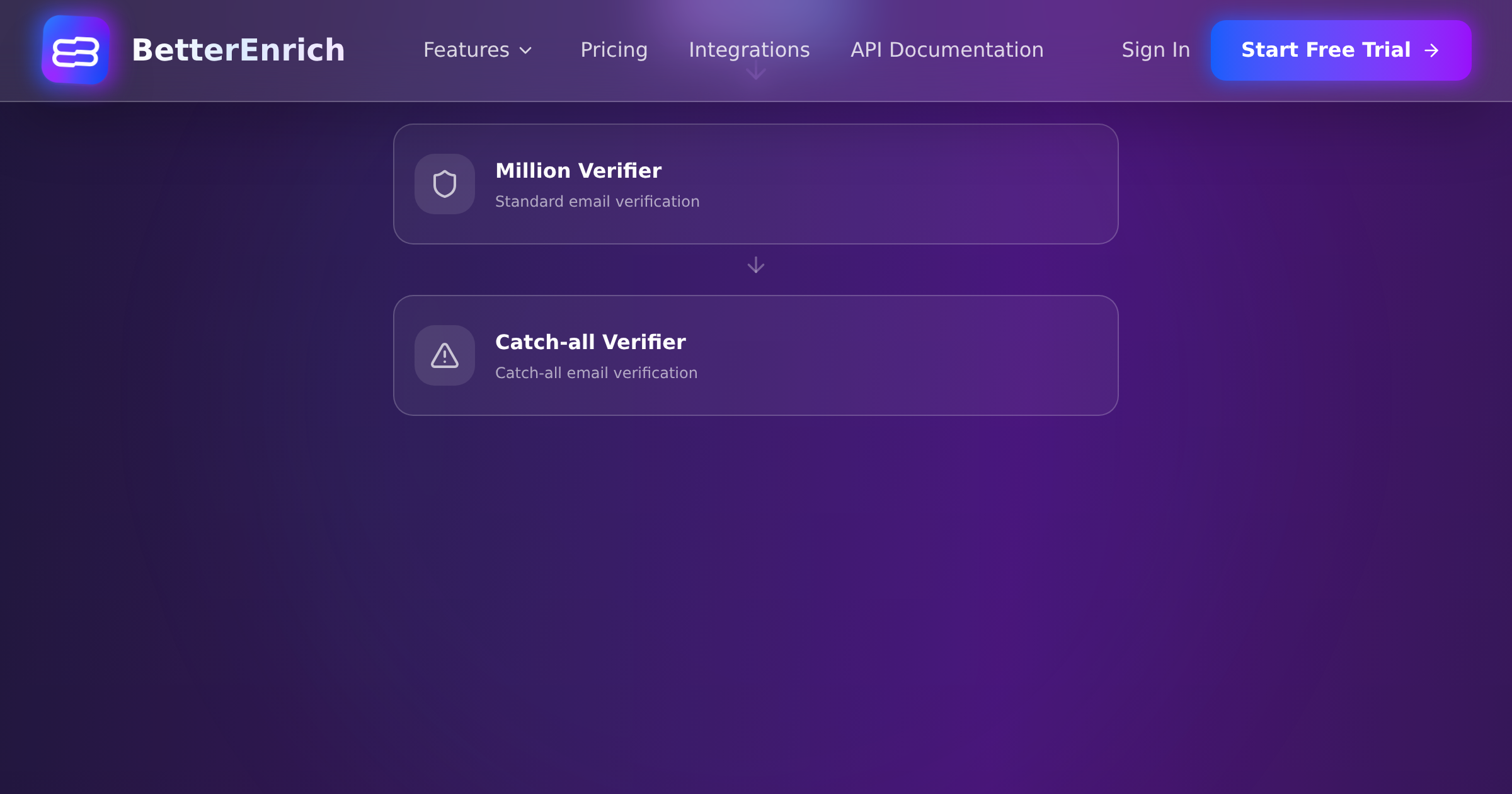
- Catch-all detection: Is the domain configured to accept everything?
- Disposable email detection: Is this a temporary email service?
- Role-based detection: Is this a shared inbox like info@ or sales@?
- Spam trap detection: Is this address a known spam trap?
The more of these checks a vendor performs, the more reliable their verification results.
The Major Verification Vendors
NeverBounce
One of the longest-running verification services. NeverBounce offers both bulk list cleaning and real-time API verification.
Strengths: established reputation, good documentation, integrates with most major CRMs and email platforms, consistent results, and a clean user interface for list uploads.
Weaknesses: pricing can get expensive at high volumes, catch-all handling is basic (flags them but does not provide confidence scoring), and some users report occasional false positives where valid addresses get marked as risky.
Pricing: roughly 0.003 to 0.008 dollars per verification depending on volume. Pay-as-you-go and subscription options available.
ZeroBounce
ZeroBounce positions itself as a premium verification service with additional data enrichment features alongside verification.
Strengths: appends additional data (name, gender, location, creation date) alongside verification, strong spam trap detection, AI-powered scoring that goes beyond binary valid/invalid, and good catch-all handling with risk assessment.
Weaknesses: premium pricing compared to competitors, the additional enrichment data is basic compared to dedicated enrichment tools, and the AI scoring can be opaque in how it reaches its conclusions.
Pricing: roughly 0.006 to 0.01 dollars per verification. Monthly subscription plans available.
BriteVerify (by Validity)
BriteVerify is part of the Validity suite (which also includes Everest for deliverability monitoring). It focuses on real-time verification at point of capture.
Strengths: fast real-time API response times (important for form verification), strong integration with Validity's deliverability tools, and enterprise-grade SLAs for uptime and accuracy.
Weaknesses: higher cost than standalone verification tools, best value when combined with other Validity products, and the interface is less intuitive for one-off list uploads.
Pricing: roughly 0.008 to 0.01 dollars per verification. Enterprise pricing available.
Kickbox
Kickbox offers a clean developer-focused API alongside a simple web interface for list uploads.
Strengths: excellent API documentation, fast bulk processing speeds, a useful sendex score that provides a deliverability prediction beyond binary valid/invalid, and good pricing for high-volume users.
Weaknesses: fewer native CRM integrations than some competitors, the web interface is minimal (this is primarily an API product), and customer support is better suited for technical users.
Pricing: roughly 0.004 to 0.008 dollars per verification. Pay-as-you-go.
BetterEnrich Built-In Verification
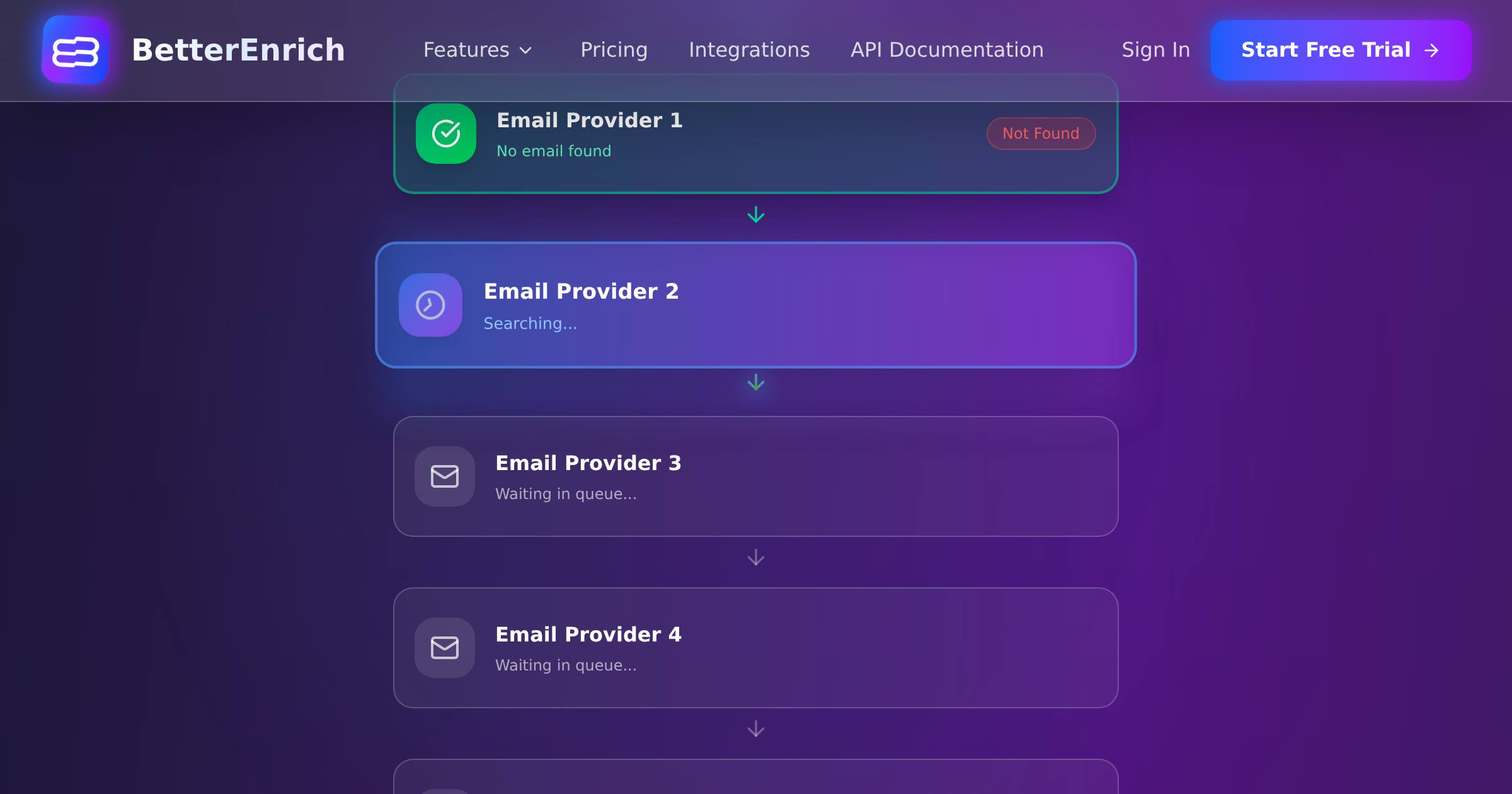
BetterEnrich includes email verification as part of its waterfall enrichment process. Rather than being a standalone verification vendor, verification is integrated into the enrichment workflow.
Strengths: verification happens automatically during enrichment so there is no separate step, pay-per-valid pricing means you only pay for contacts that pass verification, and the waterfall approach means the email was sourced from the best available provider and then verified, combining accuracy and verification in one pass.
Weaknesses: not a standalone verification product (you need to be using BetterEnrich for enrichment), and if you already have emails and just need verification without enrichment, a dedicated verification tool might be more appropriate.
Pricing: included in BetterEnrich enrichment pricing (pay-per-valid model).
Benchmark Data
A 2025 benchmark study tested major enrichment and verification tools against a dataset of 20,000 contacts. The results varied significantly:
- Top-performing tools achieved hard bounce rates of 0.9 to 1.1 percent after verification
- Mid-tier tools showed hard bounce rates of 2 to 4 percent
- Lower-performing tools had hard bounce rates of 5 to 11.2 percent
- A 14.7 percent company-email mismatch rate was found in one major tool, meaning the email technically worked but belonged to someone at a different company
These differences are enormous in practice. The gap between 1 percent and 11 percent bounce rates is the difference between healthy deliverability and potential blacklisting.
Key Evaluation Criteria
Accuracy
The only metric that truly matters. Run a test batch of 500 to 1,000 known addresses through each vendor and compare results. Include addresses you know are valid, addresses you know are invalid, and catch-all domains. Measure false positive rate (valid addresses marked invalid) and false negative rate (invalid addresses marked valid).
Speed
For bulk verification, processing speed matters when you are cleaning large databases. Most vendors process 10,000 to 100,000 records per hour. For real-time API verification (form submissions, enrichment integration), response time matters. Target under 2 seconds per verification for real-time use cases.
Catch-All Handling
This is the biggest differentiator between verification vendors. Basic vendors simply flag catch-all domains and leave you to decide. Advanced vendors provide risk scoring based on pattern analysis, cross-referencing, and historical delivery data for that domain. Better catch-all handling means fewer surprise bounces.
Integration Options
Consider how the verification tool fits into your existing workflow. Do you need native CRM integration? API access for custom workflows? Zapier or Make compatibility? Bulk upload via web interface? Choose the vendor that fits your technical capabilities and workflow needs.
Pricing Structure
Verification pricing models include: pay-per-verification, monthly subscription with included verifications, and credits with expiration dates. For predictable usage, subscriptions offer better unit economics. For variable usage, pay-as-you-go avoids waste. Avoid vendors with expiring credits unless your usage is consistent month to month.
Our Recommendation
For teams already using enrichment tools: choose an enrichment provider like BetterEnrich that includes verification in the enrichment process. This eliminates the need for a separate verification vendor and ensures that every contact is verified at the point of enrichment.
For teams that need standalone verification: Kickbox offers the best combination of accuracy, speed, and pricing for most use cases. Their sendex score provides more actionable data than a binary valid/invalid result.
For enterprise teams with high compliance requirements: BriteVerify (Validity) offers enterprise SLAs and integrates with Validity's broader deliverability monitoring suite.
For teams on tight budgets: NeverBounce provides reliable verification at competitive per-check pricing with a straightforward interface.
The Bottom Line
Email verification is not a commodity. The difference between the best and worst verification vendors is a 10x gap in bounce rates. Choose a vendor based on accuracy first, catch-all handling second, and pricing third. Better yet, use an enrichment provider that includes verification in the enrichment process so your data arrives already verified and ready to use.