Here is a number that should make every sales leader uncomfortable: SDRs spend just 2 hours per day actively selling. The other 6 hours? Research, data entry, CRM updates, internal meetings, and administrative busywork.
That means your most expensive revenue-generating resource is spending 75% of their time not generating revenue. And the biggest time sink is usually research: finding prospect contact info, looking up company details, checking LinkedIn profiles, and trying to piece together enough context to write a personalized email.
Data enrichment eliminates most of that research time. When every prospect in your pipeline comes pre-loaded with verified email, mobile phone, company size, industry, tech stack, and recent news, the SDR skips the research phase and goes straight to outreach. Here is the math and the implementation.
Where SDR Time Actually Goes
Let us break down a typical SDR day without enrichment:
- Prospect research (finding emails, phones, company info): 2-3 hours
- Writing and personalizing emails: 1-1.5 hours
- Making calls: 1-1.5 hours
- CRM data entry and updates: 1 hour
- Internal meetings and admin: 1-1.5 hours
- Actual selling conversations: 1-2 hours
The research block is the one that enrichment directly eliminates. And when research disappears, the time freed up flows into calls and emails, which are the activities that actually generate meetings and pipeline.
The Manual Research Problem
Without enrichment, here is what finding a single prospect looks like:
- Find the prospect on LinkedIn (2-3 minutes)
- Check their current title and company (1 minute)
- Search for their email using various free tools or guessing patterns (3-5 minutes)
- Try to verify the email address (1-2 minutes)
- Look for a phone number, usually unsuccessfully (2-3 minutes)
- Check the company website for size, industry context (2-3 minutes)
- Look for recent company news for personalization hooks (2-3 minutes)
Total per prospect: 13-20 minutes. At that rate, a rep can research 20-30 prospects per day before their brain turns to mush. That is barely enough to fill an outreach sequence for the week.
Manual research also degrades in quality as the day goes on. The first 10 prospects get thorough research. Prospects 25-30 get a cursory glance. Fatigue kills both quality and quantity.
The Enrichment-Powered Alternative
With automated enrichment, the same process looks like this:
- Import prospect list (names and companies) from LinkedIn Sales Navigator or a CRM list
- Run the list through waterfall enrichment (BetterEnrich): 30-90 seconds per contact, fully automated
- Receive enriched results: verified work email, mobile phone, company size, industry, tech stack, and recent funding data
- Results automatically sync to CRM
Total per prospect: approximately zero manual minutes. The enrichment runs in the background while the rep does other things. When it is done, every prospect has a complete data profile ready for outreach.
For a batch of 100 prospects, manual research takes 22-33 hours (roughly a full work week). Automated enrichment takes minutes of setup plus automated processing time. The rep does not need to babysit it.
Calculating the Time Savings
Let us get specific with the math:
Manual research per prospect: 15 minutes average
Enrichment per prospect: effectively 0 minutes of rep time
Time saved per prospect: 15 minutes
For a rep working 200 prospects per month:
Manual: 200 x 15 minutes = 50 hours/month = 6.25 days of pure research
Enrichment: approximately 0 hours of rep time
Time saved: 50 hours/month per rep
For a team of 5 SDRs:
Total time saved: 250 hours/month = 31+ days of research eliminated
That is a full-time equivalent of research labor eliminated from your team every single month. Those 250 hours can flow directly into outreach activities: more calls, more emails, more LinkedIn touches, more selling conversations.
Teams using sales automation (including enrichment) report saving 12 hours per week per rep. Our 50-hour monthly figure is even more aggressive because it specifically targets the research bottleneck rather than general automation gains.
What Reps Do with Reclaimed Time
The 80% time reduction in research does not just mean reps are less busy. It means they are more productive. Here is how the time reallocation typically breaks down:
- Additional calls: 15-20 extra calls per day (from 35 to 50-55)
- Additional emails: 20-30 more personalized emails per day
- More LinkedIn touches: 10-15 additional connection requests and messages
- Better preparation: 5-10 minutes reviewing enriched data before each call
- Follow-up: time for same-day follow-up on warm responses
The conversation volume increase is where the revenue impact happens. SDRs average 4.4 quality conversations per day. With more dials to verified mobile numbers and more email volume, that number can realistically jump to 7-10 conversations per day. At a 25% meeting conversion rate, that is the difference between 1 meeting per day and 2-3.
Implementation: Getting Started
Step 1: Audit Current Research Time
Before implementing enrichment, measure how much time your reps currently spend on research. Have them track their activities for one week. You need a baseline to measure improvement against.
Step 2: Choose Your Enrichment Platform
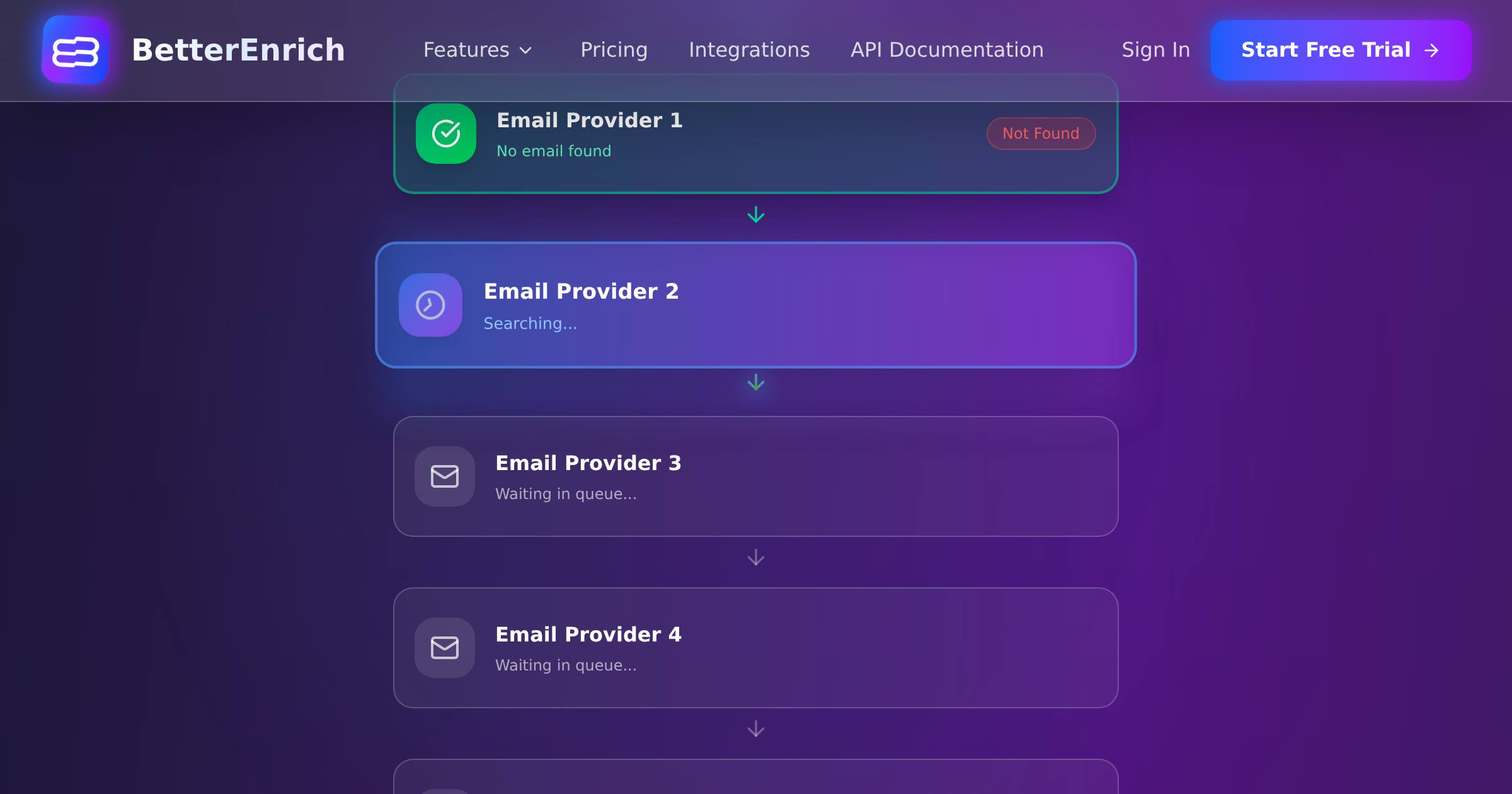
For maximum time savings, you want a platform that provides all data points in one query rather than requiring separate tools for email, phone, and company data. Waterfall enrichment platforms like BetterEnrich deliver work emails, mobile numbers, and firmographic data from a single enrichment request across 17+ sources.
The pay-per-valid model is especially important for cost control. You are only charged for contacts that return verified results. Empty lookups are free.
Step 3: Set Up Automatic Enrichment
Configure enrichment to run automatically when:
- A new lead enters the CRM (via form fill, import, or manual creation)
- A rep saves a prospect from LinkedIn Sales Navigator
- A contact record has been untouched for 90+ days (re-enrichment)
The goal is zero manual enrichment steps. The rep adds a name and company, and the system fills in everything else automatically.
Step 4: Build Templates Using Enriched Fields
Create email and call script templates that reference enriched data fields: company size, industry, tech stack, recent funding. This converts research time not just into outreach time, but into personalized outreach time.
Step 5: Measure the Impact
After 30 days, compare against your baseline:
- Research time per prospect (should drop 80%+)
- Outreach volume (should increase 40-60%)
- Conversations per day (should increase 50-100%)
- Meetings booked per rep per month (the ultimate metric)
The Cost-Benefit Analysis
An SDR earning $60K per year costs roughly $25-30 per hour fully loaded (salary, benefits, management overhead). If that SDR spends 50 hours per month on manual research, that is $1,250-1,500 per month in research labor per rep.
Waterfall enrichment for 200 contacts per month costs a fraction of that. Even at $0.15 per enriched contact, that is $30 per month in enrichment costs versus $1,250+ in manual research labor. The ROI is roughly 40x.
For a 5-person team: $6,250-7,500 per month in research labor replaced by approximately $150 per month in enrichment costs. The savings fund themselves many times over before you even count the additional pipeline generated by higher outreach volume.
Common Objections
Reps like to research. Some do. And for high-value Tier 1 accounts, deep manual research still has a place. But for the bulk of outbound prospects, automated enrichment delivers equal or better data quality in a fraction of the time. Let reps do deep research on the accounts that warrant it and let enrichment handle the rest.
The data might not be accurate. With waterfall enrichment and built-in verification, accuracy rates exceed 99% for platforms like BetterEnrich. Compare that to manual research where a rep guesses an email pattern and sends without verifying. Automated enrichment is more accurate, not less.
We already have a data provider. If you have a single-source provider at 50-70% coverage, your reps are still manually researching the other 30-50%. Switching to waterfall enrichment at 85-95% coverage eliminates most of the remaining manual work.
The Bottom Line
SDR research time is the single biggest productivity leak in most sales organizations. Eliminating it through automated enrichment is not an optimization. It is a structural transformation of how your team operates. The math is simple: less research, more outreach, more conversations, more meetings, more pipeline. And the cost of enrichment is a rounding error compared to the labor it replaces.