The sales intelligence market is a crowded, confusing place. There are enterprise platforms that cost $25K per year, scrappy startups offering free tiers, Chrome extensions that cost $30 per month, and everything in between. Some tools find emails. Some find phone numbers. Some do both. Some add intent data, engagement tools, and full CRM capabilities on top.
If you are evaluating sales intelligence vendors right now, this guide cuts through the noise. We will break down the major players by tier, compare them honestly across the dimensions that actually matter, and help you figure out which type of tool fits your team.
How to Think About the Market
Sales intelligence tools exist on a spectrum from simple (find an email address) to complex (predict which accounts will buy in the next 90 days). The right choice depends on what problem you are solving.
If you need basic contact data: email finders and Chrome extensions are sufficient.
If you need verified contact data at scale: enrichment platforms with verification are the answer.
If you need maximum coverage: waterfall enrichment platforms that query multiple sources outperform single-source tools.
If you need buying signals: intent data platforms or full sales intelligence suites are required.
If you need everything: all-in-one platforms exist, but they often compromise on depth in individual areas.
Enterprise Tier ($15K+ per Year)
ZoomInfo
ZoomInfo is the 800-pound gorilla. With 420+ million contacts and a comprehensive go-to-market intelligence platform, it is the default choice for enterprise sales teams. The platform includes contact data, company data, intent signals (via Bombora partnership), engagement tools, and website visitor identification.
Strengths: massive database, strong US coverage, comprehensive platform, intent data integration, advanced search and filtering.
Weaknesses: expensive (starting at $15K-25K per year), annual contracts with limited flexibility, some data accuracy concerns at the edges of the database, overwhelming for smaller teams.
Best for: enterprise sales teams with 20+ reps and budget to match. If you need a single platform that does everything and money is not the primary constraint, ZoomInfo is the safe choice.
6sense
6sense is an AI-powered revenue intelligence platform that combines intent data, predictive analytics, and account engagement into a unified system. Their key differentiator is using AI to predict which accounts are in buying cycles and when they will be ready to purchase.
Strengths: predictive capabilities, AI-powered insights, strong ABM features, account-level engagement tracking, intent data integration.
Weaknesses: expensive, complex to implement, requires significant data to train the models, better for marketing-led than sales-led motions.
Best for: enterprise B2B companies running sophisticated ABM programs with significant marketing budgets.
Cognism
Cognism is the strongest option for European coverage. Their Diamond Data program provides phone-verified mobile numbers, and their GDPR compliance features are built into the core platform rather than bolted on as an afterthought.
Strengths: best-in-class European data coverage, Diamond Data phone verification, strong GDPR compliance, good mobile number quality.
Weaknesses: US coverage less comprehensive than ZoomInfo, premium pricing, smaller overall database.
Best for: companies selling into European markets or with strict GDPR requirements.
Mid-Market Tier ($500-5,000 per Year)
Apollo.io
Apollo has grown aggressively and now offers 275+ million contacts with a full sales engagement platform built in. The free tier makes it accessible, and the per-user pricing scales reasonably. They recently acquired Pocus for product-led growth intelligence.
Strengths: large database, affordable pricing ($49-119 per month per user), free tier available, built-in engagement tools, good for startups and scale-ups.
Weaknesses: data accuracy concerns reported by some users, the platform tries to do too many things and some features feel incomplete, less reliable for phone data.
Best for: growing sales teams that want contact data plus engagement tools in one platform at a reasonable price.
Clearbit (now HubSpot)
Clearbit was acquired by HubSpot and is being integrated into the HubSpot ecosystem. Their real-time API enrichment is strong, and the data quality is generally good for US tech companies.
Strengths: strong API, real-time enrichment, good tech company data, deep HubSpot integration, website visitor identification.
Weaknesses: now tied to HubSpot ecosystem, expensive annual licensing historically, coverage outside US tech is weaker.
Best for: HubSpot customers who want native enrichment without additional integrations.
Lusha
Lusha is a credit-based contact data platform with a popular Chrome extension for LinkedIn enrichment. The interface is simple and the data quality for US contacts is solid.
Strengths: easy to use, good Chrome extension, credit rollover policy, solid US data quality, affordable for individual users.
Weaknesses: credit-based pricing can get expensive at scale, single-source coverage (50-70%), limited company-level data, less useful for bulk enrichment.
Best for: individual reps or small teams who need quick LinkedIn enrichment without complex workflows.
Waterfall and Multi-Source Tier
BetterEnrich
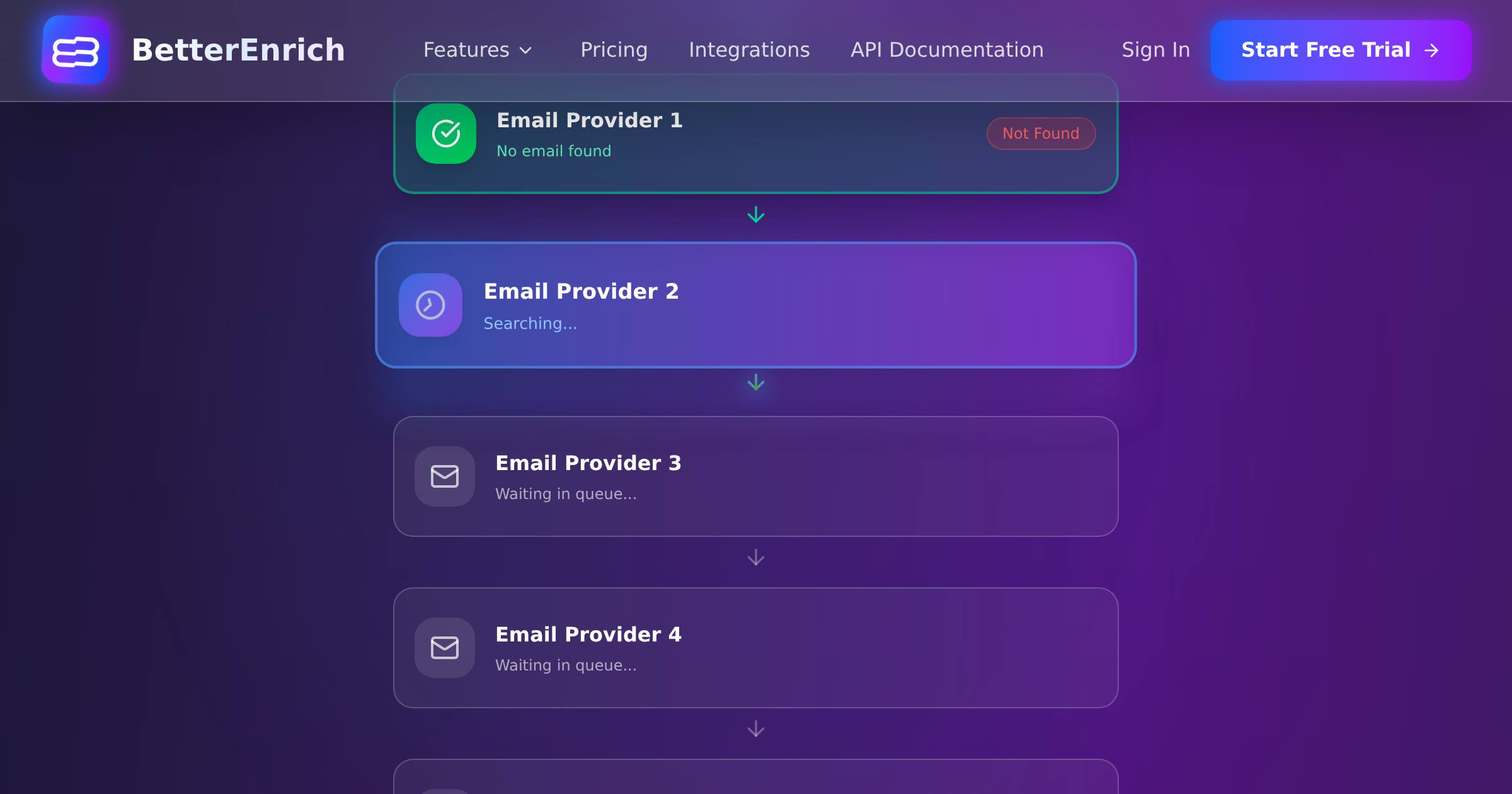
BetterEnrich queries 17+ premium data sources in a waterfall cascade, returning the first verified result. The pay-per-valid model means you only pay for contacts that come back with verified data. Coverage rates of 85-95% significantly exceed single-source alternatives.
Strengths: highest coverage rates through waterfall approach, pay-per-valid pricing eliminates waste, 99% accuracy on verified contacts, 3-step phone verification (format, line-type, location), API-first architecture, 50% cost savings versus single-source tools.
Weaknesses: API-focused (less point-and-click UI than some competitors), no built-in Chrome extension, no engagement or sequencing tools (focused purely on enrichment).
Best for: teams that need maximum coverage and verified data quality at a reasonable cost. Especially valuable for teams already using a CRM and engagement platform that just need better contact data feeding in.
Clay
Clay is a data orchestration platform that accesses 100+ data sources. It functions as a workspace where you build custom enrichment workflows, combining multiple providers in any sequence you want. No per-seat charges.
Strengths: enormous number of data sources (100+), highly customizable workflows, no per-seat pricing, strong community and templates, good for creative data operations.
Weaknesses: DIY assembly required (you build the waterfall yourself), steeper learning curve, credit-based pricing for each provider within the platform, can get expensive if not managed carefully.
Best for: data-savvy teams that want maximum customization and are willing to invest time in building and maintaining workflows.
FullEnrich
FullEnrich offers waterfall enrichment across 15+ data vendors including Apollo, DropContact, and Hunter. Direct competitor to BetterEnrich in the waterfall space.
Strengths: multi-source waterfall, reasonable coverage, growing feature set.
Weaknesses: smaller provider network than BetterEnrich, newer platform with less track record.
Best for: teams comparing waterfall options and looking for alternatives.
Budget Tier (Under $500 per Year)
Hunter.io
Hunter focuses on email finding through domain search. Enter a domain, get a list of email addresses associated with it. Simple, affordable, and effective for basic email discovery.
Strengths: simple interface, domain search capability, affordable, good for finding email patterns.
Weaknesses: email-only (no phone data), basic verification, limited to email finding without deeper enrichment.
Best for: freelancers, very small teams, or anyone who just needs emails and nothing else.
Snov.io
Snov.io combines email finding with outreach tools. Find emails, verify them, and send sequences all in one platform.
Strengths: combined find and send, affordable, decent email quality, built-in outreach.
Weaknesses: limited database size, basic compared to mid-market tools, outreach tools are functional but not best-in-class.
Best for: solopreneurs and very small teams who need an all-in-one budget solution.
How to Choose
Here is a decision framework based on team size and needs:
Solo rep or freelancer: Start with Hunter.io or Lusha for basic email finding. Upgrade to Apollo if you need more features.
Small team (2-5 reps): BetterEnrich for contact data (best coverage at fair cost) plus your choice of engagement platform. Or Apollo if you want everything in one tool.
Mid-market team (5-20 reps): BetterEnrich for enrichment plus Outreach or Salesloft for engagement. Add Bombora for intent data if budget allows.
Enterprise team (20+ reps): ZoomInfo or Cognism (for European markets) as the primary platform, potentially supplemented with BetterEnrich waterfall for contacts that the primary platform misses.
The Key Questions to Ask Every Vendor
- What is your coverage rate for my specific ICP? (Ask for a benchmark test on your actual data)
- What is your hard bounce rate on verified emails? (Get a number, not a vague accuracy claim)
- How do you handle catch-all domains? (This separates serious verification from basic checks)
- Do you charge for empty results or landlines? (Pay-per-valid is always better)
- What does your data refresh cadence look like? (Monthly refresh is minimum; quarterly is too slow)
- Can you show me ROI data from a company similar to mine? (Case studies matter more than feature lists)
The sales intelligence market will continue to evolve, but the fundamental question remains the same: can this tool help my team reach the right people with verified data, efficiently and cost-effectively? Focus on that, and the right vendor choice becomes much clearer.