The Relationship Between Data Quality and Email Reply Rates
Everyone in outbound sales obsesses over email copy, subject lines, and send times. Those things matter. But there is a factor upstream of all of them that has a bigger impact on reply rates than any copywriting trick: data quality. If you are sending to the wrong person, at a bad email address, with an inaccurate job title in your personalization, no amount of clever writing will save the campaign.
Let us look at exactly how data quality connects to reply rates, with numbers.
The Baseline: What Normal Looks Like
Average cold email reply rates sit between 1 and 4 percent depending on the industry, offer, and targeting quality. That means for every 100 cold emails you send, you should expect 1 to 4 replies. Top-performing outbound teams consistently hit 5 to 10 percent, and the primary difference is not better copywriting. It is better data.
How Data Quality Multiplies Reply Rates
Factor 1: Reaching the Right Person
The most obvious impact. If your enrichment data has the wrong email address, the right person never sees your message. If it has a valid address but for the wrong person (a common problem when enrichment tools return mismatched contacts), your perfectly personalized email about marketing automation lands in the inbox of someone in accounting.
Industry data shows a 14.7 percent mismatch rate between company names and email domains in some enrichment tools. That means nearly 1 in 7 emails might go to someone at the wrong company entirely. You cannot get a reply from the right person if you are emailing the wrong one.
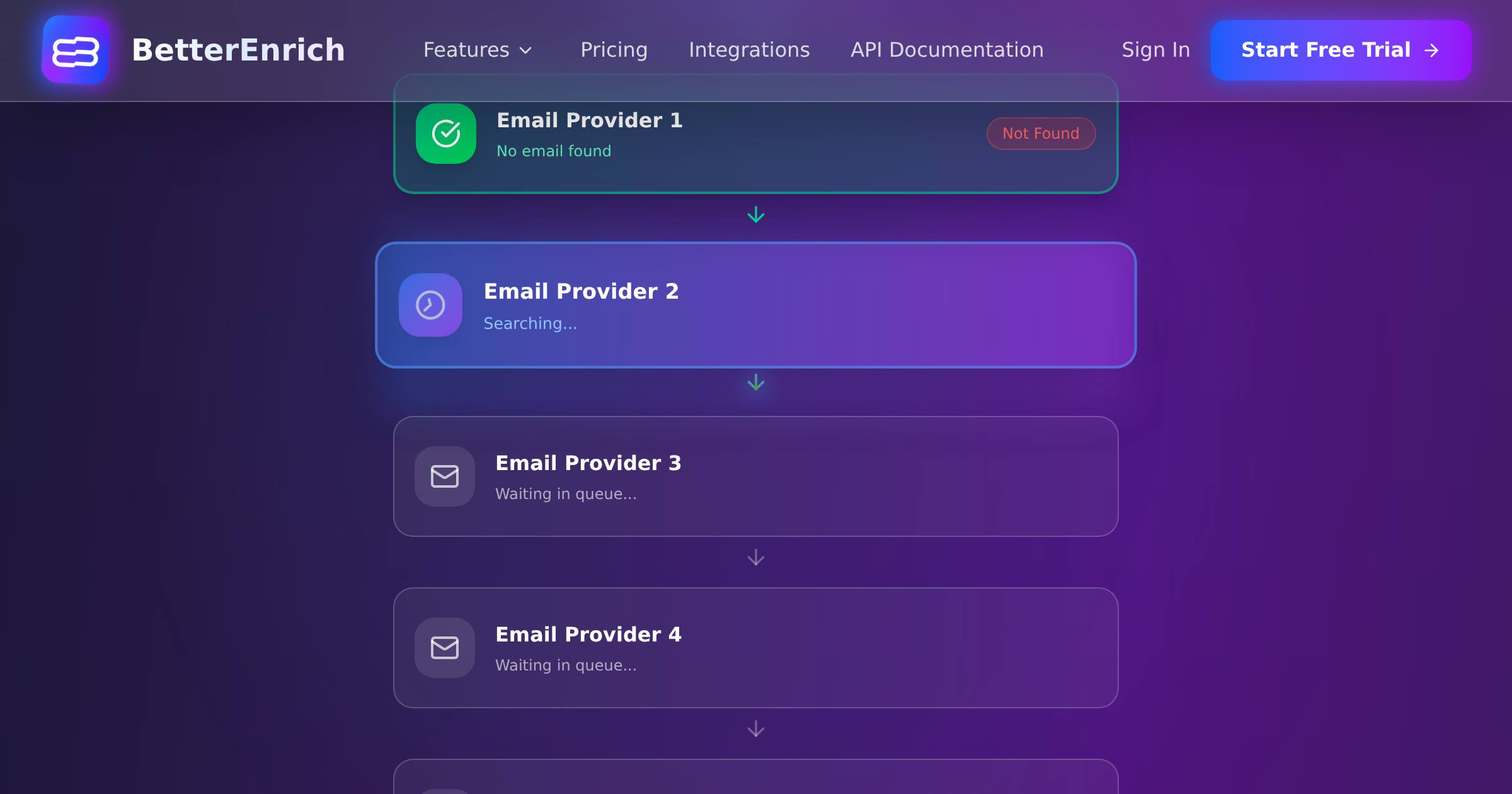
Fix: Use waterfall enrichment tools like BetterEnrich that cross-reference across 17 or more sources to verify that the email actually belongs to the person and company you think it does.
Factor 2: Accurate Personalization
Modern cold outreach relies heavily on personalization. You reference the prospect's title, company size, tech stack, recent funding, or hiring patterns to make the email feel relevant. But personalization only works if the data is accurate.
Imagine opening an email that says: Hi Sarah, I noticed that as VP of Engineering at TechCorp, you are scaling your team rapidly. But Sarah left TechCorp six months ago. Or she is the VP of Product, not Engineering. The personalization backfires because it reveals that you did not actually do your research. You just ran her through a database and auto-filled some fields.
Enriched data with recent verification avoids this. When job titles are current (verified within the last 90 days), company details are accurate, and trigger events are real, personalization genuinely increases relevance and reply rates jump.
The numbers: personalized cold emails using enriched data get 2 to 3x higher reply rates compared to generic templates. Add accurate company-specific details (tech stack, growth signals, industry challenges) and you get another 1.5 to 2x on top of that. Combined, you are looking at a potential 3 to 6x improvement from data quality plus personalization versus generic blasts.
Factor 3: Deliverability
Before a prospect can reply, they have to receive the email. And email deliverability is directly tied to data quality. Every hard bounce from an invalid address damages your sender reputation. Accumulated reputation damage pushes future emails to spam, even emails going to perfectly valid addresses.
Think about it as a chain reaction: bad data causes bounces, bounces hurt reputation, damaged reputation sends good emails to spam, spam placement kills reply rates for the entire campaign. One bad enrichment source can tank the performance of your entire outbound operation.
The numbers: teams that verify 100 percent of their email lists before sending see bounce rates of 0.5 to 1.5 percent, which protects reputation and maintains inbox placement above 85 percent. Teams that skip verification average 7.5 percent bounce rates, which degrades reputation and can drop inbox placement below 70 percent. The deliverability gap alone can account for a 2x difference in reply rates.
Factor 4: Right Timing
Enriched data that includes trigger events (funding rounds, leadership changes, hiring spikes, tech stack adoptions) lets you time your outreach to moments when prospects are most likely to respond. Reaching out right after a company raises a funding round or hires a new VP of Sales catches them during a window when they are actively evaluating solutions.
Without enrichment, you are sending at random times and hoping your message happens to be relevant. With enrichment-powered trigger events, you are sending when you know it is relevant.
Quantifying the Compounding Effect
Let us stack these factors to see how data quality compounds across a campaign of 1,000 emails.
Scenario A: Low-quality data (no enrichment, no verification).
- Bounce rate: 7.5 percent (75 emails bounce)
- Inbox placement: 70 percent of the remaining 925 reach inbox = 648 emails seen
- Personalization accuracy: low (generic templates), reply rate from inbox: 1.5 percent
- Replies: approximately 10
Scenario B: High-quality data (waterfall enrichment, verification, trigger events).
- Bounce rate: 1 percent (10 emails bounce)
- Inbox placement: 90 percent of the remaining 990 reach inbox = 891 emails seen
- Personalization accuracy: high (enriched fields, trigger events), reply rate from inbox: 5 percent
- Replies: approximately 45
Same number of emails sent. 4.5x more replies. The entire difference is data quality.
Which Data Points Matter Most for Reply Rates
Not all enrichment data equally impacts reply rates. Here are the fields ranked by their contribution to outreach performance:
- Verified email address: The foundation. No valid email, no reply. Non-negotiable.
- Current job title: Enables role-specific personalization and confirms you are reaching a decision-maker.
- Company size and growth signals: Lets you tailor your value proposition to their stage and scale.
- Tech stack: Enables competitive displacement messaging and compatibility arguments.
- Trigger events: Funding, hiring, leadership changes. Creates timing relevance.
- Industry: Enables industry-specific language and case study references.
- Mobile phone number: Not for email reply rates directly, but enables multi-channel follow-up that increases overall response rates.
Building a Data-First Outreach Workflow
If you want to maximize reply rates, build your workflow around data quality rather than adding it as an afterthought:
- Start with ICP definition. Define your ideal customer profile using firmographic and technographic criteria before you enrich a single contact.
- Enrich with waterfall sources. Use a tool like BetterEnrich that cascades through 17 or more data sources for maximum coverage and accuracy.
- Verify before sequencing. Re-verify every email address before it enters a sending sequence. Data decays at 2.1 percent per month, so even recently enriched addresses should be re-checked.
- Personalize with enriched fields. Use company size, tech stack, and trigger events in your email templates. Make the personalization specific enough that the prospect knows it was written for them.
- Monitor and iterate. Track reply rates segmented by enrichment source, personalization type, and data freshness. Double down on what works.
The Bottom Line
Reply rates are not primarily a copywriting problem. They are a data quality problem. The teams that consistently hit 5 to 10 percent reply rates are not magical wordsmiths. They are teams that invested in accurate, verified, enriched data that enables genuine personalization, clean deliverability, and timely outreach. Fix the data and the replies follow.