How to Merge Data from Multiple Enrichment Sources Without Creating a Mess
If you are using more than one data enrichment provider (and you probably should be), you have almost certainly run into this problem: Provider A says the contact's title is VP of Marketing while Provider B says Vice President, Growth Marketing. Provider A has a personal Gmail address. Provider B has a work email at a different domain than the company website. Which one do you trust?
Welcome to the data conflict resolution problem. It is the unglamorous but absolutely critical challenge that sits at the heart of any multi-source enrichment strategy. Get it right and you have a clean, reliable database. Get it wrong and you end up with a CRM full of contradictory information that nobody trusts.
Why Conflicts Happen in the First Place
Different enrichment providers pull from different underlying data sources, and those sources get updated at different frequencies. Some providers scrape public web data. Others aggregate from partnership networks. Some rely on user-submitted data or browser extensions. A few use AI to infer information from patterns.
The result is that the same contact can look different depending on which provider you ask. The most common conflict categories include:
- Job title variations: Same role, different phrasing. Head of Sales versus VP Sales versus Sales Director might all describe the same position at the same company.
- Company name formatting: IBM versus International Business Machines versus IBM Corporation all refer to the same entity but will create duplicate records if your matching logic is too strict.
- Email addresses: One provider might find a work email while another finds a personal one. Or both find work emails but at different company domains, which is common after acquisitions or rebrands.
- Phone numbers: One provider returns a direct dial, another returns a mobile, a third returns the company switchboard. All technically valid but with very different usefulness for outreach.
- Location data: Work-from-home has made location data particularly unreliable. One provider shows the corporate HQ address, another shows the contact's home city.
The Source Priority Hierarchy
The single most important decision you will make in data merging is establishing a source priority hierarchy. This is a ranked list that determines which provider's data wins when there is a conflict.
There is no universal right answer here because it depends on your specific providers and what you are using the data for. But here is a general framework that works for most B2B sales teams:
Tier 1: First-party verified data. Information the contact has given you directly through form fills, email replies, business cards, or conversation notes. This always wins.
Tier 2: Phone-verified data. Providers that verify data through actual phone calls to the company sit at the top of third-party sources. Human verification catches things automated tools miss.
Tier 3: Multi-source validated data. When multiple providers agree on a data point, that agreement increases confidence. If three out of four providers say the same title, you can be fairly confident.
Tier 4: Single-source data with high provider reliability. Some providers are consistently more accurate for specific data types. You will learn which ones through experience.
Tier 5: Inferred or pattern-based data. Email addresses generated from patterns or job titles inferred from profile text sit at the bottom of the priority stack.
Practical Conflict Resolution Strategies
Strategy 1: Most Recent Wins
The simplest approach is to always use the most recently updated data point, regardless of source. The logic is straightforward: newer data is more likely to be current, especially given that B2B contact data decays at 2.1 percent per month.
This works well for fields that change frequently, like job titles and phone numbers. It works less well for fields that rarely change, like company founding year or industry classification.
Strategy 2: Consensus Voting
When you have three or more enrichment sources, you can use a consensus approach: the value that the majority of providers agree on wins. This is particularly effective for job titles and company names, where variations are common but the underlying truth is the same.
The downside is that consensus does not work well when you have only two providers or when the correct answer is the minority opinion, which happens when a contact recently changed roles and most providers have not caught up yet.
Strategy 3: Field-Specific Source Assignment
Rather than having one global priority hierarchy, you assign specific providers as the authority for specific fields:
- Provider A is your authority for email addresses because they have the best email verification
- Provider B is your authority for phone numbers because they specialize in phone verification
- Provider C is your authority for firmographic data because they have the deepest company database
- LinkedIn serves as your ground truth for job titles because people keep their profiles reasonably current
This approach requires more setup but produces the best results because you are playing to each provider's strengths.
Strategy 4: Confidence Scoring
Some enrichment platforms return a confidence score alongside the data. A 95 percent confidence email address should beat an 80 percent confidence one from a different provider, regardless of your general source hierarchy.
If your providers do not return confidence scores, you can build your own by tracking the accuracy of each provider over time. Run quarterly audits where you sample 100 to 200 records and verify them manually.
Building Your Data Merge Workflow
Step 1: Normalize Before You Merge
Before comparing data from different sources, you need to normalize it into a consistent format:
- Standardizing company names (remove Inc., Corp., LLC suffixes for comparison)
- Normalizing job titles to a standard taxonomy
- Formatting phone numbers to E.164 international format
- Lowercasing email addresses
- Standardizing location data to city, state, country format
Step 2: Match Records Across Sources
You need a reliable way to determine that Record A from Provider 1 and Record B from Provider 2 are the same person. The best matching approach uses a combination of email address as primary identifier, full name plus company domain as secondary, and LinkedIn profile URL as tertiary.
Step 3: Apply Your Resolution Rules
For each matched record pair, apply your conflict resolution strategy field by field. Log every conflict and the resolution decision for audit purposes.
Step 4: Create a Golden Record
The output of your merge process is a single golden record for each contact that contains the best available value for every field. Store the individual provider values somewhere accessible so you can trace back to the source when needed.
Step 5: Handle New Conflicts Automatically
Your merge logic should not be a one-time thing. Every time you re-enrich a contact or add a new data source, automate your resolution rules so they apply on every enrichment cycle.
Common Pitfalls and How to Avoid Them
Overwriting Good Data with Bad Data
The most dangerous mistake is blindly overwriting existing CRM data with enrichment results without checking whether the existing data is better. If a rep manually confirmed a contact's direct dial last week, you do not want an automated enrichment run to replace it with a switchboard number. Solution: implement protect flags for manually verified fields.
Creating Duplicate Records
When your matching logic is too strict, you end up with multiple records for the same person. Duplicate rates in unmanaged CRMs typically run 10 to 30 percent. Solution: use fuzzy matching on company names and implement multiple match criteria.
Losing Data Provenance
Once you merge data from multiple sources into a single record, you lose track of where each piece came from. This becomes a problem for troubleshooting, GDPR compliance, or evaluating provider performance. Solution: maintain an enrichment audit log that records the source, timestamp, and original value for every field update.
Not Handling Null Values Properly
When Provider A returns a value and Provider B returns null on a re-enrichment, does null mean the data is no longer valid or that Provider B does not have it? Solution: never overwrite existing data with null values from enrichment. Only clear a field when you have positive evidence the old value is wrong, such as a bounce on a verified email.
Tools That Help with Data Merging
If you are doing this at scale, several approaches can help:
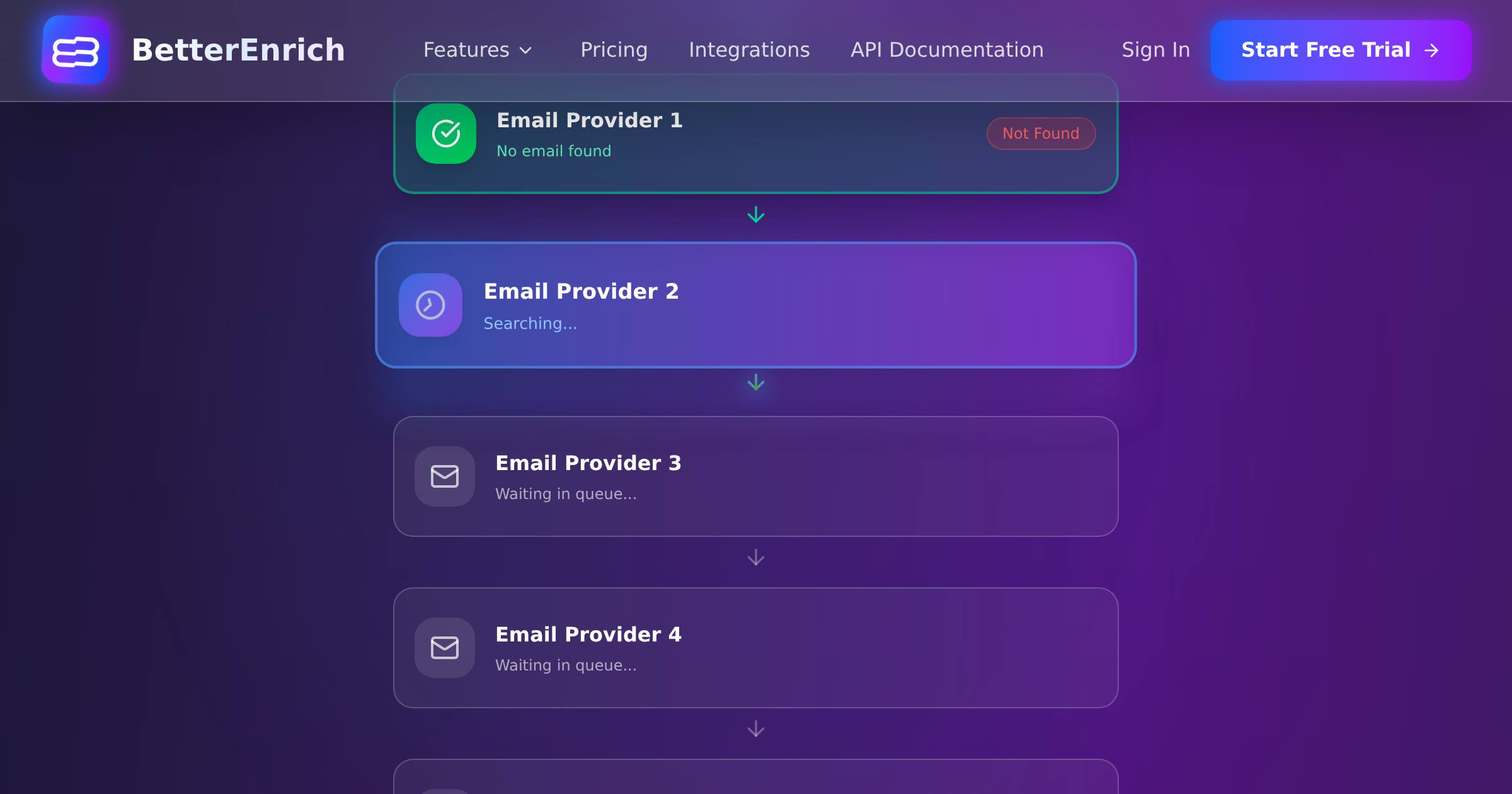
- Waterfall enrichment platforms like BetterEnrich handle the multi-source problem internally. They query 17 or more providers in sequence and return a single best result, so you do not have to build merge logic yourself.
- Data orchestration tools like Clay let you define merge rules across 100 or more data sources with visual workflow builders.
- CRM-native deduplication in Salesforce and HubSpot can handle basic matching and merging.
- Middleware like Zapier or Make can implement simple priority-based merge logic for lightweight needs.
For most teams, using a waterfall enrichment provider that handles multi-source merging internally is the lowest-effort path. You get the coverage benefits of multiple data sources without building and maintaining the merge logic yourself.
Monitoring Merge Quality Over Time
Your merge rules are not set-and-forget. Data provider quality shifts over time. Build a regular review cadence:
- Monthly: Review conflict logs for patterns. If a specific provider is consistently losing conflicts, either their data quality has dropped or your priority rules need updating.
- Quarterly: Sample 100 to 200 merged records and manually verify them against LinkedIn and company websites.
- Annually: Reassess your provider mix. Are you getting enough incremental value from each source to justify the cost?
Wrapping Up
Multi-source enrichment delivers significantly better coverage than relying on a single provider. But that coverage advantage only translates to better sales results if you manage the data merging well. Define your source priority hierarchy. Normalize before comparing. Log everything. And review your rules regularly. Do those four things and you will get the coverage benefits of multi-source enrichment without the data quality headaches.