The difference between a cold call and a warm call often comes down to timing. You can have the perfect pitch, the right contact, and a genuinely good product, but if you reach out at the wrong time, none of it matters. The prospect is not thinking about your category. They are focused on something else entirely.
Sales triggers flip that equation. A trigger event is something that happens at a company that creates a need, a budget, or a timeline for purchasing. When you catch a trigger event and reach out within days, you are not cold calling anymore. You are solving a problem they are actively dealing with.
This guide catalogs every major trigger event type, explains why each one signals buying intent, and shows you how to monitor them so you never miss an opportunity.
What Makes a Good Sales Trigger
Not every company event is a sales trigger. A good trigger has three qualities: it creates urgency (something needs to change), it creates budget (money is being allocated), and it creates a timeline (decisions need to happen within a window).
The best triggers hit all three. A company that just raised $50M in Series C funding has urgency (they need to scale fast), budget (they literally just got $50M), and a timeline (investors expect returns within 18-24 months). That is a near-perfect trigger event.
Funding and Financial Triggers
Venture Capital Funding Rounds
When a company raises venture capital, they are about to spend money. Seed rounds fund product development. Series A funds go-to-market. Series B and beyond fund scaling. Each stage creates demand for different tools and services.
A company that just closed a Series B is probably hiring sales reps, which means they need CRM, enrichment tools, and sales engagement platforms. The buying window after a funding round is typically 3-6 months.
IPO Announcements
Companies going public need to professionalize everything. Compliance tools, financial reporting, enterprise-grade infrastructure. The pre-IPO window (6-12 months before filing) is when procurement budgets open up.
Mergers and Acquisitions
When two companies merge, systems need to be consolidated. Two CRMs become one. Two marketing stacks become one. Every vendor relationship gets re-evaluated. If you sell the tool the combined company should standardize on, this is your moment.
Revenue Milestones
When a company crosses revenue thresholds ($1M, $10M, $50M, $100M ARR), they typically outgrow their existing tools. The scrappy startup stack breaks at $10M. The mid-market stack breaks at $50M. Watch for companies announcing revenue milestones in press releases or industry reports.
People and Leadership Triggers
New Executive Hires
A new CRO, VP of Sales, or CMO almost always brings change. New leaders want to put their stamp on the organization. They evaluate every vendor, rethink every process, and often bring their preferred tools from their previous company.
The first 90 days of a new executive hire is your window. After that, decisions are made and budgets are committed. Job title changes affect 65.8% of contacts within 12 months, so there are always new leaders entering new roles.
Key Departures
When a champion at one of your accounts leaves, that is both a risk and an opportunity. Risk because your renewal might be in jeopardy. Opportunity because that person just landed at a new company that might need your product.
Rapid Hiring
A company posting 20+ job openings in a month is growing fast. If they are hiring sales reps, they need sales tools. If they are hiring marketers, they need marketing tools. Job postings reveal pain points: a posting for a data analyst who can fix CRM data quality tells you exactly what they are struggling with.
Layoffs and Restructuring
Counterintuitive, but layoffs can be a buying trigger. Companies that downsize often need to do more with less, which means automation and efficiency tools become more attractive, not less.
Technology Triggers
New Technology Adoption
When a company adopts a new CRM, they need everything that integrates with it. When they migrate to a new cloud provider, they need the entire ecosystem around it. Technographic data from enrichment platforms reveals these changes.
Contract Renewals
Most B2B software contracts are annual. If you know when a competitor contract is up for renewal, you can start the conversation 3-4 months ahead. Technographic enrichment combined with contract timing intelligence is incredibly powerful.
Technology Stack Gaps
If a company uses Salesforce and Marketo but has no data enrichment tool, that is a gap you can fill. Technographic data reveals not just what companies use, but what they are missing.
Business and Market Triggers
Office Moves and Expansions
A company opening a new office is growing. They need everything from IT infrastructure to staffing solutions. Geographic expansion into new regions means they need local market data and contacts.
Product Launches
Companies launching new products need to build pipeline fast. That means demand generation, outbound prospecting, and the data infrastructure to support it. Watch for product launch announcements in press releases and on social media.
Industry Regulation Changes
New regulations create urgency. When GDPR went into effect, every company in the EU needed compliance tools. When new data privacy laws pass, companies need to re-evaluate their enrichment and data handling practices.
Competitive Losses
When a competitor has a public stumble (data breach, outage, price increase, bad PR), their customers start looking around. Monitor competitor news and reach out to their customer base when problems surface.
Award and Recognition
Companies that win industry awards or land on growth lists (Inc. 5000, Deloitte Fast 500) are growing and investing. They are also more receptive to outreach because they are in a confident, forward-looking mindset.
How to Monitor Trigger Events
You do not need to manually track all of these. Several tools and approaches automate trigger monitoring:
- Google Alerts: free and simple for company-specific news (funding, hires, launches)
- LinkedIn Sales Navigator: tracks job changes and company news for saved accounts
- Crunchbase: funding round monitoring with alerts
- BuiltWith and HG Insights: technographic change detection
- Bombora and 6sense: intent data that captures research behavior
- Job board scrapers: monitor new job postings for hiring signals
- SEC filings: IPO announcements and financial disclosures
The key is connecting these signals to your enrichment and outreach workflow. When a trigger fires, automatically enrich the key contacts at that company and route them to the right rep.
Building Trigger-Based Outreach Sequences
Each trigger type warrants a different message. Here is how to match triggers to outreach:
Funding trigger: lead with growth. Congratulate the raise and connect your solution to their scaling challenges. Do not be salesy. Be helpful.
New hire trigger: acknowledge the transition. New leaders are building relationships and gathering information. Position yourself as a resource, not a vendor.
Technology trigger: lead with integration. If they just adopted a tool that integrates with yours, make the connection explicit. Show how the combination creates more value than either tool alone.
Competitive trigger: be subtle. Never trash the competitor directly. Instead, acknowledge that transitions are disruptive and offer to show how your approach differs.
Combining Triggers with Enrichment
A trigger event without contact data is just interesting news. To act on triggers, you need verified contact data for the decision-makers at the triggered account.
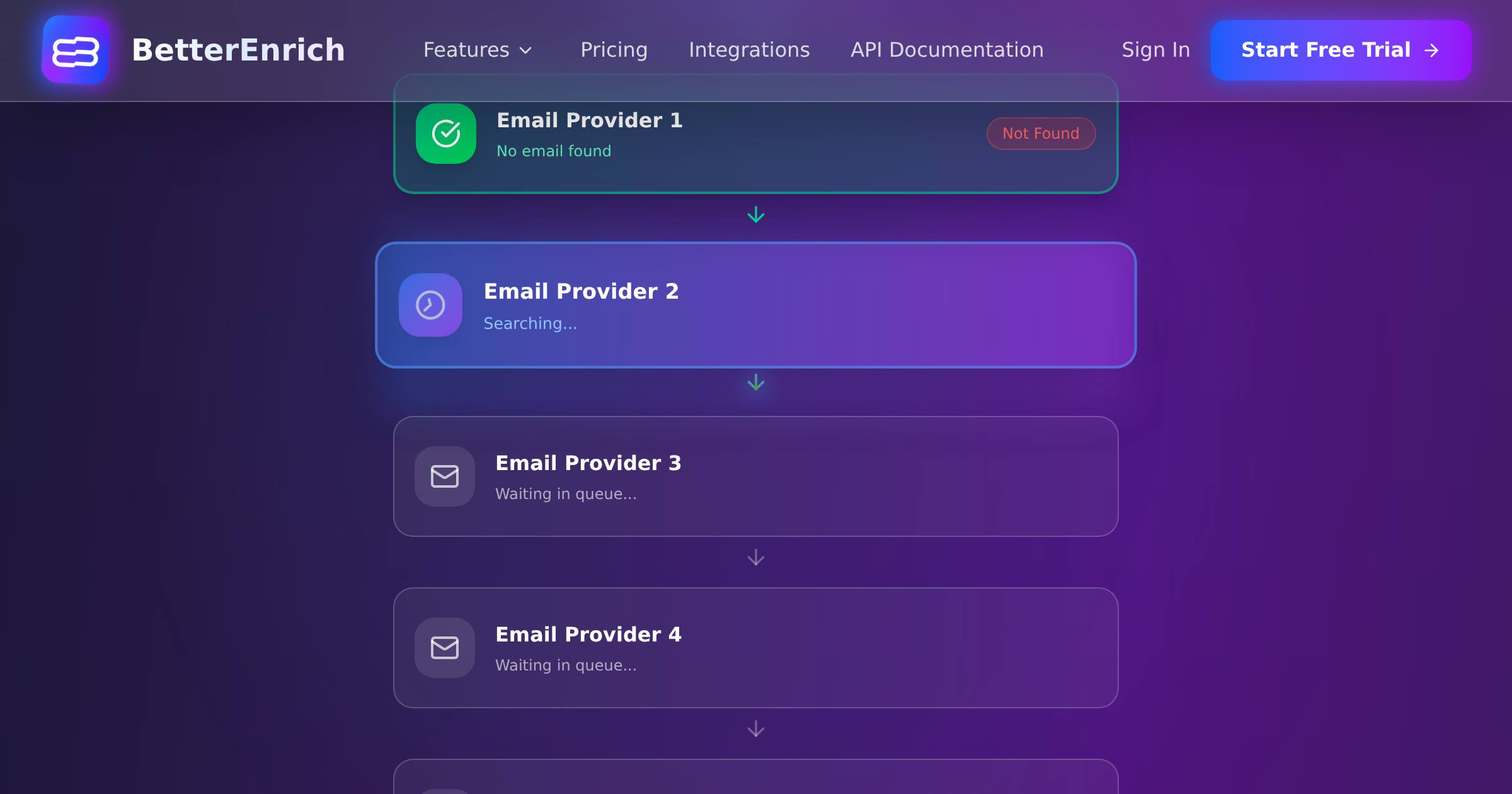
Waterfall enrichment is essential here. When a funding trigger fires, you need to quickly find the CRO, VP of Sales, and Head of Revenue Operations at that company. Single-source tools might find 2 out of 3. A waterfall platform like BetterEnrich, cascading through 17+ sources, will likely find all of them with verified emails and mobile numbers.
The speed matters too. Trigger events have a shelf life. A funding announcement is hot news for a week. A new executive hire is most approachable in the first 30 days. If your enrichment takes days instead of minutes, you are missing the window.
Measuring Trigger-Based Selling
Track these metrics to prove the value of trigger-based outreach:
- Reply rate on trigger-based sequences vs. standard sequences (expect 2-3x improvement)
- Meeting conversion rate from triggered accounts (expect 25-50% higher)
- Pipeline generated from trigger-based outreach as a percentage of total pipeline
- Average deal velocity for triggered accounts vs. non-triggered (expect 30-40% faster)
First-mover advantage delivers a 50% higher win rate. Trigger-based selling, powered by fast enrichment and verified contact data, is how you become the first mover consistently.