HubSpot's acquisition of Clearbit reshaped the enrichment landscape. For HubSpot users, it created a native enrichment layer built directly into their CRM. For everyone else, it created uncertainty about Clearbit's future as a standalone product and whether non-HubSpot users would continue to have access to the same capabilities.
If you are evaluating enrichment tools in 2026, the Clearbit question comes down to one thing: are you on HubSpot or not? That single factor determines whether Clearbit is your easiest option or whether an alternative like BetterEnrich makes more sense.
What Changed After the Acquisition
Before the acquisition, Clearbit was known for real-time API enrichment that worked with any tech stack. Companies used it for form enrichment, visitor identification (Clearbit Reveal), and CRM data enrichment regardless of which CRM they used. The product was respected for data quality but criticized for expensive annual licensing with minimum commitments.
After the acquisition, HubSpot integrated Clearbit's enrichment capabilities natively into the HubSpot platform. For HubSpot customers, this is a significant value add. Enrichment happens automatically within HubSpot's interface without needing separate API calls or third-party integrations. Contact and company records get populated with Clearbit data as part of the standard HubSpot experience.
For non-HubSpot users, the picture is less clear. Clearbit's standalone API products continue to exist, but the development focus has understandably shifted toward HubSpot integration. Non-HubSpot customers have reported concerns about long-term support, pricing changes, and feature parity with the HubSpot-native version.
BetterEnrich as the CRM-Agnostic Alternative
BetterEnrich was built as an API-first enrichment tool that works with any CRM, any workflow, and any tech stack. It does not favor one CRM over another because it is not owned by a CRM company. This CRM-agnostic approach means equal integration support whether you use Salesforce, Pipedrive, Zoho, Copper, Monday, or any platform with API access.
The waterfall architecture is the primary technical differentiator. While Clearbit relies on its own proprietary database, BetterEnrich cascades through 17 or more external data sources. This means BetterEnrich is checking significantly more databases for each lookup, resulting in higher coverage rates. Industry benchmarks put single-source coverage at 50 to 70 percent versus 85 to 95 percent for waterfall approaches.
Coverage and Data Quality
Clearbit's data quality has been generally well-regarded, particularly for technology companies and North American contacts. Their database is strong on firmographic data (company size, revenue, industry) and technographic data (technology stack identification). Email enrichment is solid, though phone data has been a weaker area historically.
BetterEnrich's waterfall approach addresses the coverage gap inherent in any single database. By querying multiple providers, it finds contacts that Clearbit's single database misses. This is especially impactful for contacts at smaller companies, those in non-tech industries, international contacts outside core markets, and recently changed job holders whose new information has not propagated to all databases yet.
Phone data is an area where BetterEnrich differentiates strongly. The three-step phone verification process (format validation, line-type detection, and location verification) combined with multiple data sources for phone lookups delivers higher mobile number find rates. No charge for landlines means you only pay for the mobile numbers your sales team actually needs.
Pricing Comparison
Clearbit's pricing model has been a point of friction for many customers. Annual licensing with minimum commitments means you are paying whether you use the credits or not. The pricing is not publicly listed, which makes comparison difficult, but users have reported annual costs in the range of several thousand to tens of thousands of dollars depending on volume and features.
BetterEnrich's pay-per-valid model charges only for successful, verified lookups. No annual commitment, no minimum spend, and no charge for lookups that do not return valid data. For teams with variable enrichment needs or limited budgets, this flexibility is significant. You start with 100 free credits with no credit card required, making evaluation frictionless.
The total cost comparison depends on your usage pattern. If you enrich a consistent, predictable volume each month and are locked into HubSpot, Clearbit's bundled pricing may be competitive. If your enrichment needs fluctuate or you want to avoid annual commitments, BetterEnrich's pay-per-valid model provides better cost control.
Integration and Workflow
For HubSpot users, Clearbit integration is essentially zero effort. Enrichment happens natively within HubSpot workflows, forms, and record views. This is the most compelling argument for Clearbit in a HubSpot environment.
For non-HubSpot users, BetterEnrich offers API documentation at betterenrich.readme.io, plus integration through Zapier, Make, and n8n. The API supports both synchronous single lookups and asynchronous bulk processing. Setting up a BetterEnrich integration typically takes 1 to 2 hours for a basic CRM connection and a few days for a more sophisticated enrichment pipeline.
If you use Salesforce, Pipedrive, Zoho, or another CRM, BetterEnrich is the easier path because it was designed for multi-CRM compatibility from the start. You are not fighting against a product roadmap that prioritizes a competing CRM platform.
Feature Comparison Matrix
Clearbit offers: company enrichment, contact enrichment, website visitor identification (Reveal), form shortening, advertising audience building, and HubSpot-native workflows. It is a broader platform with use cases beyond basic enrichment.
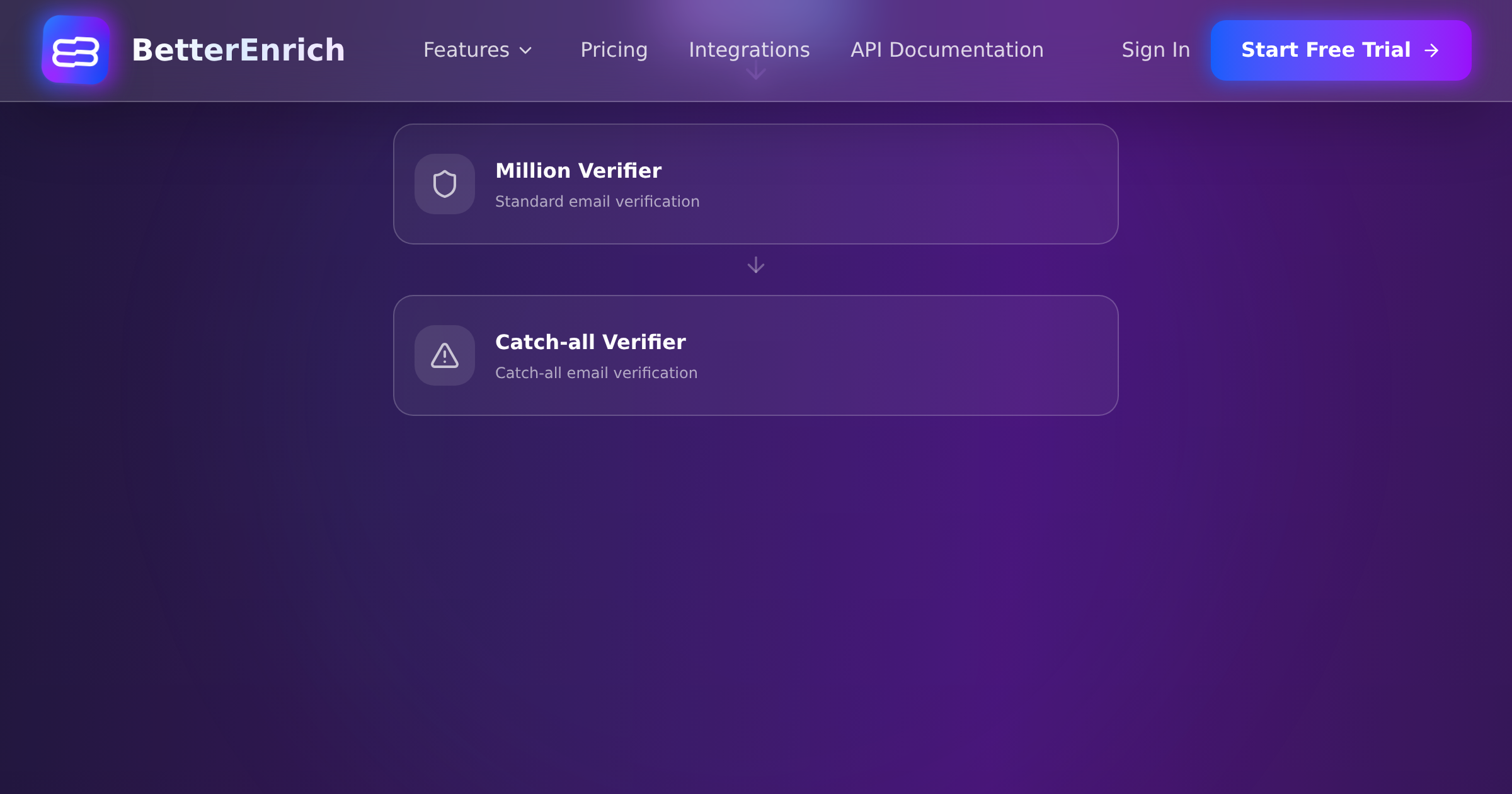
BetterEnrich offers: waterfall email discovery, work and personal email identification, mobile phone discovery, three-step phone verification, standard email verification, catch-all email verification, automatic failover, and API access. It is laser-focused on finding and verifying contact data as accurately as possible.
The feature comparison reveals different philosophies. Clearbit is a platform that does enrichment plus several adjacent functions. BetterEnrich is a specialized tool that does enrichment exceptionally well and integrates with best-of-breed tools for adjacent functions.
When to Choose Clearbit
Choose Clearbit if you are deeply invested in the HubSpot ecosystem and want native enrichment without managing integrations. It is also the right choice if you need website visitor identification (Clearbit Reveal) as a core workflow, since BetterEnrich does not offer that specific feature natively. For HubSpot-centric teams that value simplicity over maximum coverage, Clearbit is the pragmatic choice.
When to Choose BetterEnrich
Choose BetterEnrich if you use a CRM other than HubSpot, need the highest possible coverage rates through waterfall enrichment, want verified mobile numbers for cold calling, prefer pay-per-valid pricing over annual commitments, or need an API-first tool that fits into a custom enrichment pipeline. For teams that prioritize data coverage and cost efficiency over platform breadth, BetterEnrich delivers more value per dollar spent.
The Bigger Picture
The HubSpot acquisition of Clearbit is part of a broader trend of CRM platforms acquiring enrichment capabilities. This vertical integration benefits users of those specific CRMs but creates challenges for everyone else. As enrichment tools get absorbed into CRM platforms, standalone alternatives like BetterEnrich become more important for maintaining vendor independence and avoiding CRM lock-in.
The enrichment market is moving toward two camps: CRM-native enrichment (Clearbit for HubSpot, and likely similar acquisitions from other CRM vendors) and independent enrichment tools that work across any stack. Your choice between these camps should align with your broader technology strategy, not just your enrichment needs in isolation.